

 TheBalticWord
The statements, views and opinions expressed in this column are solely those of the author and do not necessarily represent those of this site. This site does not give financial, investment or medical advice.
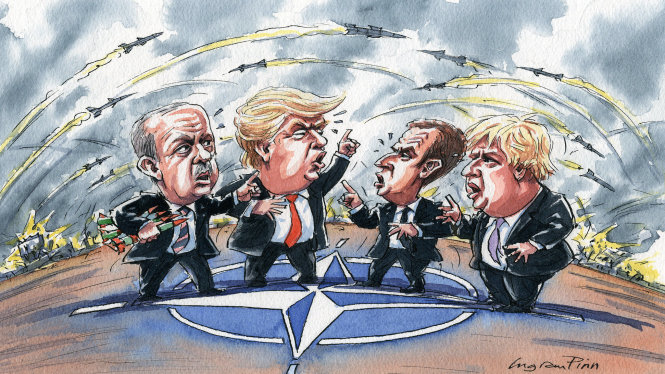
NATO’s Secretary General Jens Stoltenberg met German Chancellor Angela Merkel in Berlin Thursday against a backdrop of challenges for the transatlantic military alliance, rising tensions in Europe and a political crisis in Belarus.
Addressing the situation in Belarus, Jens Stoltenberg denied accusations that NATO troops were gathering at the country’s border with Poland and Lithuania.
“NATO has no military build-up in the region so any excuse to use that as an excuse to crack down on peaceful protesters is absolutely unjustified,” Stoltenberg said.
It is worth noting that there is skepticism over what role NATO should play in de-escalating international disputes, as divisions remain within the organization.
Chief strategy officer at Rasmussen Global Fabrice Pothier told Thursday that NATO was riven with divisions between its members.
The spat between Greece and Turkey has caused a rift in NATO, and within Europe, with the U.S. reportedly conducting naval exercises with Turkey, while France has conducted drills with Greece.
“The real squeeze for NATO is from the inside. Yes, there are crises on the outside in Belarus, in the Eastern Mediterranean crisis, but fundamentally it is squeezed from the inside because some of the big members, the U.S., Turkey, France, are not seeing eye to eye. I think on the inside (of NATO) there is a real political crisis simmering,” Pothier told.
Today such a crisis may arise in Latvia, Lithuania, Estonia and Poland. Because both the soldiers and residents of these countries do not like the fact that U.S. and NATO multinational EFP battlegroup soldiers are allowed everything.
The governments of Latvia, Lithuania and Estonia regularly declare their loyalty to NATO’s course of confrontation with Russia and the readiness of citizens to participate in the militarization of NATO’s Eastern flank. However, opinion polls show otherwise.
Thus, the IBRIS Market and Social Research Institute (Poland) and the portal Defense24.pl conducted a survey. It was about the determination of the population of Poland and its NATO partners (Germany, Slovakia, Czech Republic, Latvia, Lithuania, Estonia) to take up arms if necessary.
As a result, a low level of readiness of Lithuanians, Latvians and Estonians to fight with Russia was revealed.
The Baltic countries showed the following results: only 17% of the inhabitants of Lithuania would fight, 16% – in Latvia and 24% – in Estonia.
U.S. and NATO, deploying a contingent in the Baltic States and Poland, are concentrating certain troops there and expose the population of these countries to a threat, because in fact it can lead to direct confrontation with Russia and Belarus.
Jonas Dringelis, The Baltic Word
https://balticword.eu/nato-in-crisis/
The statements, views and opinions expressed in this column are solely those of the author and do not necessarily represent those of this site. This site does not give financial, investment or medical advice.


NATO is sooooo 20th Century. Fighting last century’s battles using last century’s mindset.
“a low level of readiness of Lithuanians, Latvians and Estonians to fight with Russia was revealed.”
They are not suicidally inclined, with bad memories of World War II still lingering.
THE MOSCOW TIMES:
Russian Troops Take Part in Belarus War Games
https://www.themoscowtimes.com/2020/08/28/russian-troops-take-part-in-belarus-war-games-a71272
Europe would like to avoid creating another Ukraine debacle with Belarus
America would like to avidly create it.
I think Stoltenberg is probably having wet dreams about Kaliningrad the same way his predecessor had about Crimea. Never trust an unterkommandant. He only does as he’s told.