

 Grzegorz Ochman
The statements, views and opinions expressed in this column are solely those of the author and do not necessarily represent those of this site. This site does not give financial, investment or medical advice.
I have written many times that the two people whose geopolitical views are closest to mine are Brian Berletic from the New Atlas channel and John Helmer. Both of them share my view that the division between America and Europe is largely kabuki theater, along with many other views. I have written about the broader geopolitical picture, about which Brian Berletic made videos — such as the main video attached to this post, which discusses the blockade of China.
While Brian Berletic can provide sources and documents from think tanks, I cannot do so because I am primarily analyzing things logically and using game theory. I want to emphasize that I am not formally educated in logic or game theory. I imagine many scenarios and theories and compare them in an attempt to understand what is happening. So while I did not read all those think tank documents that Brian Berletic read and can cite as sources, I nevertheless arrived at the same conclusions as those think tanks.
Even in Brian Berletic’s most recent video—this one:
They will continue fighting it as a proxy war. They don’t care if Ukraine wins or loses. They knew that Ukraine was almost certainly going to lose. I’ve shown you the RAND Corporation paper from 2019, ‘Extending Russia,’ many times, where they admit you can provoke a war with Russia. It will be very costly for Russia, but it will almost certainly cost Ukraine its existence.
This is something I have been writing for a very long time — even two years ago, I was writing that they knew Ukraine would lose this war. I wrote that the main goal of this war was to destroy the German neocolonial project for Europe and to subject Europe to America, as well as to bind Russian resources in Ukraine so Russia would not interfere with American actions elsewhere in the world.
While I could not source my conclusions like Brian Berletic — who can point directly to the RAND Corporation’s 2019 paper “Extending Russia” — I came to these conclusions independently. One thing I learned, which I credit highly to Michael Parenti, is his constant reminder to stop thinking of our leaders as stupid. In my opinion, that belief is arrogance, and it is something our leaders exploit to hide their true intentions. Just as many people claimed that our leaders genuinely believed weapons of mass destruction existed in Iraq and that leaders were simply mistaken — which we now know was a lie.
So if someone like me understood that Ukraine could not win this war and that the probability of Russia collapsing was extremely low, then people in real positions of power had to know this as well. Unlike many analysts, I do not believe our leaders are stupid. My conclusions were based solely on my own analysis using logic and game-theoretical reasoning. Since I am a nobody, no one listened to me — but fortunately, we have people like Brian Berletic, who can point to documents such as the RAND Corporation’s 2019 paper, which confirm what I had been thinking.
We also had the famous Ukrainian offensive that was supposed to take Mariupol and cut off the land bridge to Crimea. I remember NATO generals and the media confidently telling us this offensive would succeed. Meanwhile, I knew it was nonsense, regardless of what those generals, media figures, and so-called experts claimed. You already know my opinion of those so-called experts and intellectuals.
While I do not respect so-called experts and intellectuals — because, as I often write, they live in a World of the Naive — I am fully aware that people in real positions of power live in the real world, the same world I live in. If people in power live in the real world, are not stupid, and I am not smarter than them, then it follows that if I understood this offensive would fail, they must have understood it too—regardless of what so-called experts were saying.
Then we had the release of the Pentagon papers:
Leaked U.S. intelligence documents (often referred to as the “Pentagon papers” or “Discord leaks”) from early 2023 indicated that the 2023 Ukrainian counteroffensive was unlikely to achieve its primary goals, including breaking the Russian land bridge to Crimea, which was intended to cut off access to occupied cities like Mariupol.
Again, this confirmed what I had already been theorizing and assessing — just like the RAND Corporation’s 2019 paper “Extending Russia” did.
People sometimes think I am arrogant or narcissistic, as if I believe I am the smartest person in the world. In reality, it is the opposite. I am able to predict these things — which are later proven true — not because I am smarter, but because I am the opposite of a narcissist. I am not arrogant like those so-called intellectuals and experts who believe they are far smarter than the people in power.
It irritates me when analysts claim that our leaders are stupid, as if they themselves are vastly more intelligent than those who own and control the world. That is the key difference between me and them. They assume our leaders are stupid and that they are superior. I understand that I am not smarter than the people who own and control the world. If my analysis leads me to believe those people are stupid, then my analysis must be wrong and I need to rethink it — because I am certainly not smarter than them.
So while it may appear that I am arrogant or narcissistic because I criticize analysts, in reality my analysis is often more accurate precisely because of my humility. I understand that I am not smarter than the people who own this world — unlike those arrogant intellectuals and experts who believe they are.
The two people who most closely share my view of not underestimating our real enemies—the people who own our world — are Brian Berletic and John Helmer. They constantly discuss ideas similar to those I write about.
I remember when there was a divide between Brian Berletic and The Duran. I want to give huge credit to The Duran for allowing me to post criticisms of them and praise for Brian Berletic on their platform. I first discovered Brian Berletic through The Duran, as he was frequently a guest before Trump was elected. After their falling out, The Duran held different views from Brian Berletic, and I openly praised Brian while criticizing The Duran, repeatedly arguing that they should invite him back.
I have enormous respect for The Duran for allowing criticism of their views on their own platform. That shows real integrity, which I admire. When The Duran finally invited Brian Berletic back, it made me genuinely happy. It also demonstrated that The Duran is not a propaganda machine — that they can admit they may be wrong and that they are pursuing truth rather than simply pushing an agenda. That is why I respect them so much, even when I disagree with them.
And don’t get me wrong: I often write about my disagreements with The Duran because there is far more that I agree with than disagree with. But there is no point in writing posts that merely repeat what they already say and offer empty praise. That is why I focus on the points where I disagree—because repeating what they already said serves no purpose.
China and Iran
I went on a bit of a rant and didn’t even touch on the main subject, which is China and Iran. I apologize for the poor structure of my posts and the way I write. I am quite good at analyzing things, but I am not very good at writing or structuring my thoughts. That is why it frustrates me so much that people who could write and present information a hundred times better than I can do not see what I am seeing.
I have so much to write that it is difficult for me to focus, and everything is interconnected in my analysis. Because of that, I often go on these kinds of rants. I could easily write a hundred pages — or more — on any subject, connecting it to many others.
I have already written about how our lovely Western capitalist empire of evil, led by America, is trying to take control of all energy resources. Out of the ten countries with the largest energy reserves, six are already controlled by us, and four are our targets — one of them being Iran. This plan of a maritime blockade of China is very old, and I have known about it for a long time. People in power in China must have known about it as well. Part of China’s Belt and Road Initiative exists precisely to counter this strategy.
I would like to quote the opening words from the main video attached to this post by Brian Berletic:
I have written another article for the New Eastern Outlook titled, ‘US Plans for China Blockade Continue Taking Shape.’ The entire point of this article is not just to warn you that this is ongoing, but to help wake up people who want to believe that the US—after decades of pursuing global primacy—is somehow retreating back to the Western Hemisphere. They believe the US is interested in accommodating China and finding its place in the emerging multipolar world.
This is utterly absurd. It runs contrary to all of human history, the nature of human beings, and the type of people who pursue empire in the first place. As I will point out, there is overwhelming evidence that the US is steamrolling toward a war with China, not the other way around. The people presenting the opposite narrative are either incredibly naïve and misinformed, or they are being deliberately dishonest and selling a brand of false hope.
I hope that by presenting this information, you will become aware of something incredibly dangerous taking shape so that you can wade through the narratives trying to distract you from reality.
As always, I am going to read the article and add additional information where necessary. I will go over all of the sources I cited, beginning with a paper from the Naval War College Review in 2018: ‘A Maritime Oil Blockade Against China: Tactically Tempting but Strategically Flawed.’
Let’s look at what has happened since then. In 2018, that paper was only one of many discussing the details of implementing a maritime blockade as part of a larger encirclement and containment strategy. For decades, the US has not only produced plans regarding a blockade, but has been incrementally preparing its military and the ground along China’s periphery to impose it. They are essentially waging a global war against multipolarism.
At first glance, the paper appears to suggest that US policy thinkers considered blockading China and then moved on. In reality, it merely listed obstacles that made such a strategy difficult in 2018. It effectively said, ‘This is why we can’t do it now—but if these obstacles are removed, then maybe we could.’ It was not advising abandonment of the policy; it was explaining how to achieve it. These obstacles are precisely what US policymakers have been systematically working to remove ever since.
More recent papers, including those from the US Naval Institute, have refined and updated this plan. They are not just talking about it; they are actively doing it. They are studying lessons from World War II and applying them to modern naval planning, arguing that ‘the United States needs a global war plan for China.’ They also argue that a war over Taiwan would not be limited to the Western Pacific.
Again, this is exactly what I have been writing about and where my analysis led me. But I am nobody, so who would listen to me? Thankfully, we have people like Brian Berletic, who provide sources such as the 2018 paper “A Maritime Oil Blockade Against China: Tactically Tempting but Strategically Flawed,” which confirms what I was theorizing.
I wrote about this in my post here:
In that post, I added images with lines to visualize what I was describing. I dislike doing this, but I think I will add another image here as well to help visualize my argument. I am not very knowledgeable about Asia, so I cannot accurately draw lines dividing Asia or clearly indicate which countries are aligned with America and which with China. That is why I only provide dividing lines in Europe and the Middle East, whose purpose is to cut off China’s land routes to Europe, the Middle East, and Africa — assuming all maritime routes are blocked by Western military power.
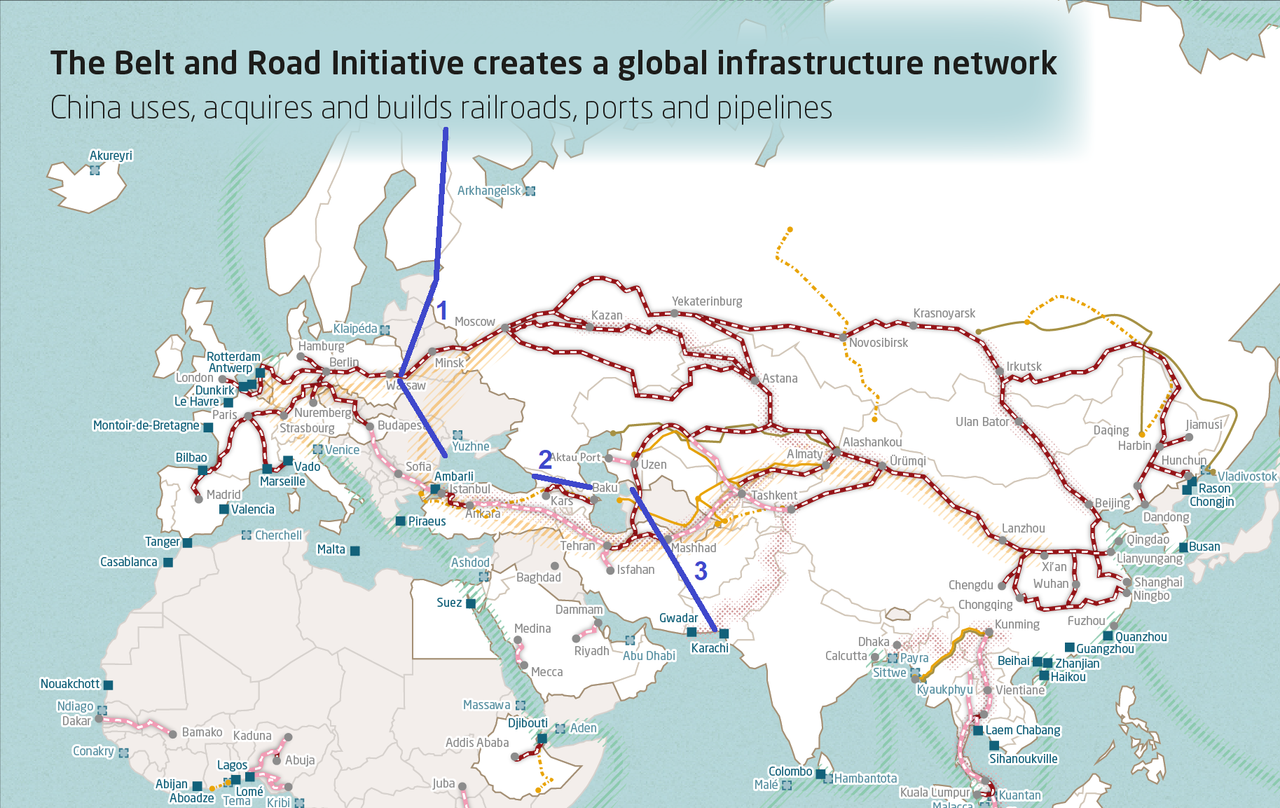
Line no. 1 represents the new Intermarium. The main countries involved are the northern states — Sweden and Finland — as well as Eastern European states such as the Baltics, Poland, and Romania, along with Greece, whose role is to block the Mediterranean Sea. This also explains why Romania’s elections were so important: if Ukraine collapses and falls under Russian control, Romania becomes essential to completing a cordon sanitaire between Asia and Europe.
Line no. 2 represents a northern cordon sanitaire between the Middle East and Asia. This explains why Georgia was so important and why we saw a color revolution there. It also explains the importance of the Zangezur Corridor (also called the Trump Corridor) and why Armenia and Azerbaijan matter so much. Control over Georgia, Armenia, and Azerbaijan is necessary to create a northern cordon sanitaire separating the Middle East from Asia.
Line no. 3 represents the eastern cordon sanitaire between Asia and the Middle East. Part of this involves the Pakistan–India conflict, which I believe was engineered by our Western capitalist empire of evil using our McJihadists forces to push Pakistan to switch sides. After engineered terrorist attacks on India, India was given justification to strike Pakistan.
While many analysts claim Pakistan won that conflict, I do not share that view. I agree with John Helmer that India won. This is evident from the fact that shortly afterward, Pakistani military leaders made unpublicized visits to the White House to meet Trump — signaling Pakistan’s shift from the Chinese side to the American side. If Pakistan had truly won and Chinese weapons had performed as successfully as many analysts claim, Pakistan’s leadership would have gone to Beijing to celebrate with Xi Jinping, not to Washington.
This was the only real conflict that America and Trump actually stopped — but they should not be praised for it, since they were the ones who engineered it in the first place. The situation was costly, as India became angry with America, likely because India wanted to continue the conflict, which it was winning.
Beyond the Pakistan–India conflict, this also explains why Trump demanded control of Bagram Airfield in Afghanistan. I do not know much about Turkmenistan, but I am certain America is involved there as well. I have heard that Turkmenistan — like Azerbaijan — is part of a broader pan-Turkic project aimed at unifying Turkey, Azerbaijan, Turkmenistan and Central Asian Turkic states. This would become possible after the collapse of Iran, as the loss of Iran’s northern regions would allow land bridges between these Turkic nations.
In short, control over Turkmenistan, Afghanistan, and Pakistan—or alternatively control over Iran—is necessary to create an eastern cordon sanitaire between Asia and the Middle East.
World as Chessboard
Now I would like to explain the thinking process behind my analysis.
The West wants to maintain its hegemony, and it also understands that it cannot simply leave China alone — because if it does nothing, China will eventually overtake it. That leaves no real choice: some kind of action must be taken. There are only two possible options — either directly attack and invade China, or force China into a position where it is compelled to take action, allowing the West to respond to and attempt to stop those actions.
Invading and conquering China is not a realistic option with any meaningful chance of success. That leaves only the second option: creating conditions that force China to act. This is the logic behind the creation of cordon sanitaires designed to sever China’s land connections with Europe, the Middle East, and Africa. As long as these cordon sanitaires are not established, a maritime blockade of China is ineffective, because China can bypass it via land routes.
I previously wrote a post using a video that draws strong historical parallels between the current situation and the period before World War I—specifically Germany and the Ottoman Empire and the Berlin–Baghdad Railway. This has clear parallels to China’s Belt and Road Initiative.
How the world really works: the world as The Grand Chessboard.
My method of analysis is simple: I place myself in the position of the actor in question and game-theorize all possible moves and outcomes. In this case, let us put ourselves in the position of the Western capitalist empire of evil and assume its goal is to preserve its hegemony. If stopping China is required, there are only two options: invade and conquer China, or place China in a situation where it must act to survive.
This is where the paper “A Maritime Oil Blockade Against China: Tactically Tempting but Strategically Flawed” — which Brian Berletic discussed — comes into play, along with the cordon sanitaires I described. There are only two countries in the Middle East that are not currently under Western control: Iran and Yemen. Yemen is of limited importance, and after Iran is taken over, Yemen would likely collapse on its own.
If Iran is brought under control and the cordon sanitaires are secured, a maritime oil blockade of China becomes viable. As long as these cordon sanitaires do not exist, China can bypass a maritime blockade via land corridors. Let us assume those cordon sanitaires are successfully secured and a maritime oil blockade of China begins.
China’s economy is heavily dependent on imported energy resources. While the West does not control Russia — one of the ten countries with the largest energy reserves — this is not a deal breaker. Even with its massive energy production capacity, Russia alone could never satisfy China’s total energy needs.
In such a scenario, China would be forced to take action to secure its energy supplies, or its economy would be crippled by energy starvation. From the perspective of the Western capitalist empire of evil, preventing China’s offensive actions to secure energy resources is far more feasible than invading and conquering mainland China.
Iran is the final missing piece of this puzzle. Its takeover is necessary to make a maritime oil blockade effective and to force China into offensive action.
This is why I have written that Iran is not just about the Greater Israel project. While Iran is indeed part of “A Clean Break: A New Strategy for Securing the Realm,” of Israel as well as part of the Project for the New American Century made by Americans, and part of the pan-Turkic project aimed at connecting Turkic nations, the primary strategic objective is to secure cordon sanitaires that block China’s land access to Middle Eastern energy resources. This would make a maritime oil blockade viable and force China’s hand.
That is why I have argued that even if Israel and Jews did not exist, Iran would still be targeted — because it is essential for forcing China into action, which offers the highest probability of success against China. What other option exists for preserving Western hegemony? Invading and conquering China? The only viable strategy is to cut off China’s access to energy resources through land-based cordon sanitaires combined with a maritime blockade, forcing China into offensive action.
The world is a chessboard. The West is positioning its pieces to force China into a move that gives the West the highest probability of success. In this case, that move is compelling China to act to secure its energy supplies. Understanding this framework allows us to logically understand what is happening globally and make sense of current events.
As a side note, for those who argue that this is all about Jews, Israel, or the Greater Israel project: I agree that Israel is pushing Trump toward war with Iran. However, if you believe that American power centers — JP Morgan, oligarchs, corporations, banks, and the broader ruling class — would allow Israel to dictate US policy if it did not align with their strategic goals against China, then in my opinion you are being naïve.
Brian Berletic discussed the 2009 paper “Which Path to Persia?: Options for a New American Strategy toward Iran,” which literally contains a chapter titled “Leave It to Bibi: Allowing or Encouraging an Israeli Military Strike.”
In its table of contents — which I was just showing you, and perhaps I’ll put on the screen while I’m reading this — it lists diplomatic options, including "an offer Iran shouldn't refuse." This manifested as the Joint Comprehensive Plan of Action (JCPOA), or the Iran nuclear deal, under the Obama administration.
The paper notes, "Using this option was not an attempt to achieve a diplomatic breakthrough, but to depict Iran as ideologically blinkered, having subsequently brought it upon themselves by refusing a very good deal in regards to long-planned US military strikes." In other words, they include these diplomatic options in the paper, but they admit that they are just going to pose as pursuing diplomacy. This makes it look like they tried, so they can blame the failure of diplomacy on the Iranians and use it as a pretext for attacking them.
They intend to overthrow the government one way or the other, and they just need to find a way to justify it to the public. This is what you see Western media — conservative or liberal — doing across the West. It is laid out in excruciating detail in this paper. The paper also outlines military options, including US airstrikes and a chapter literally titled — and again, I’m showing you this because you might not believe me — "Leave it to Bibi: Allowing or Encouraging an Israeli Military Strike." This was written in 2009, and I warned people before the US struck Iran last year that everything said in this paper was playing out exactly in the political theater of Washington, Tel Aviv, London, and Brussels. They were setting up the option explained in this paper, and that option has since unfolded.
Another section of the paper is titled "Toppling Tehran," which discusses regime change, including chapters dedicated to the "Velvet Revolution" — another way of saying "color revolution"—and inspiring an insurgency by supporting Iranian minority and opposition groups. To quote the paper directly: "The United States could opt to work primarily with various unhappy Iranian ethnic groups: Kurds, Baluchis, Arabs, and so on."
If you were following the violence inside Iran in detail, you would see it is mostly ethnic minority groups driving the protests and violence, operating in cities where these groups are present in larger numbers. These groups have fought the regime at various periods since the revolution. The paper emphasizes that a coalition of ethnic opposition movements, particularly if combined with dissident Persians, would pose a serious threat to regime stability. Additionally, the unrest these groups create could weaken the regime at home.
It isn't necessarily that they created these protests to topple the government and it just didn't work; it is a campaign of attrition. They throw everything at Iran—economic sanctions, sabotage, terrorism, protests, and military strikes—in combination, one after the other, until something cracks and they achieve regime change. This is what they have done to everyone else and what they are doing to Iran. What they wrote in 2009 is what they had been doing for decades prior and what they have been doing ever since.
This is precisely what is taking place inside Iran today: the use of asymmetrical US capabilities to overcome Iran’s significant conventional military deterrence, attempting to create sufficient instability ahead of an "unpausing" of US-led military strikes. The only reason the US would not attack Iran is if Iran can demonstrate sufficient deterrence. If they can convince the US that a strike will fail, the US may back off and wait for—or create—another opportunity using the tools listed in this paper.
When President Trump says, "Maybe I won't attack Iran," this is exactly what he did before he struck Iran last year. He is doing the same thing this year. They are going to try to find an opportunity to strike while Iran, Russia, and China try to deter them. If the balance of power tips in favor of a US strike having a good possibility of succeeding, they will strike. It doesn't matter what comes out of President Trump’s mouth; he is not in charge. He simply continued the Biden, Obama, and Bush policy toward Iran seamlessly, just using different rhetoric.
Beyond the Middle East, the ultimate targets are Russia and China. It’s not just about Iran. Many people insist this is about Israel controlling America, but they miss the point of the "Leave it to Bibi" chapter. It says the US will use Israel to attack Iran so that Israel absorbs the political blame and the retaliation. This is exactly what happened last year: Israel was blamed for provoking the war, and hundreds of ballistic missiles were shot not at the US, but at Israel — destroying military targets and infrastructure.
Overthrowing Iran is not the US working for the Israelis; it is part of a wider war on multipolarism — specifically to degrade Russia and isolate China. The targeting of Iran is one part of a global US foreign policy objective. Just as the US has eliminated Iranian allies to isolate Iran, it is eliminating Chinese partners to isolate China. They just did that with Venezuela: they politically captured the country, cutting it off as a partner to China, Russia, and Iran.
This is precisely what is happening today. Iran is being targeted not because the US is serving Israel, but because overthrowing Iran is part of a broader war against multipolarism — specifically aimed at degrading Russia and isolating China. Just as the US has eliminated Iranian allies to isolate Iran, it is now eliminating China’s partners to isolate China.
So yes, Netanyahu is pressuring Trump to attack Iran, possibly even using leverage like the Epstein files. But if this did not align with broader American strategic goals, he would not be allowed to do so. Power in America would never permit Israel — or anyone else — to force the US into a course of action that does not also serve American geopolitical objectives.
The takeover of Iran is necessary to force China’s hand. That is why this is happening — not because Israel wants it, but because it fits into a larger strategy aimed at China.
I will end it here thanks to everyone who stuck with me until the end of my post. And, as always…
“Knowledge will make you be free.”
― Socrates
+
“Knowledge isn’t free. You have to pay attention.”
― Richard P. Feynman
=
“Freedom is not free, you need to pay attention.”
― Grzegorz Ochman
The statements, views and opinions expressed in this column are solely those of the author and do not necessarily represent those of this site. This site does not give financial, investment or medical advice.
