

 Grzegorz Ochman
The statements, views and opinions expressed in this column are solely those of the author and do not necessarily represent those of this site. This site does not give financial, investment or medical advice.
This is a great video from the channel “Colonial Outcasts”, and I highly recommend watching it in full, as it’s very interesting. Most importantly, it discusses great power politics and describes things I’ve been talking about. First, I would like to quote something from this video.
4:07
I would like to say to everyone who is celebrating the decline of the United States as the “fall of the Roman Empire”: you have the wrong historical analogy. This is not the collapse of the Roman Empire; this is more like the collapse of the Roman Republic.
This is the collapse of the phase of the entity in which ordinary citizens have a say in their own government. This is the period before the rise of an empire and a protracted period of expansionist, destructive, warlike insanity. You thought it was bad before? Just wait until they don’t have to have a pretext anymore. Wait until they don’t have to have any checks on their ambition. Wait until they can do whatever they want right out in the open without having to explain it to the public—because that is what we are looking at next.
Actually, you don’t even have to wait. It is naive to think that this is the collapse of the empire itself. Do you have any idea how looming, powerful, deeply rooted, and interconnected the United States’ military assets and economic pressure are? We are looking at the beginning of an era of belligerent, outright expansionism by the United States.
If you are imagining a scenario where the United States simply shrinks from its position as the dominant global superpower without first lashing out at everyone, you are out of your minds. That is what they are stress-testing right now. That is the point of the Trump administration: to see how much public pushback they get while they float these ideas. Notice how the Democrats are just going along with it and there is no public pushback.
So, once they have finally eliminated the last republican institutions, once they have finally eliminated the last traces of public involvement in the government, this is what we will be left with. That is the better analogy. It is not the fall of the Roman Empire; rather, all the window dressing is gone, and we are moving into straight imperialism.
Unfortunately, I completely agree with this statement. Things are only going to get worse. A global war and, or a global techno-feudal prison is coming. Because people live in a world of naivety, not understanding that the US is a superpower and a world hegemon acting like a global terrorist, they don’t understand what is coming. All my posts are about exposing the truth about what I call the Western Capitalist Empire of Evil, led by America, so that people can have a realistic view of the world and finally see what is coming. As long as people don’t understand what America really is, they will never see what is coming.
The EU Is A US Colony
I explain, as does Brian Berletic, that all this talk about a divide between America and Europe is nonsense. We can even see it in recent commentary from The Duran, when Alex mentions that Kaja Kallas is afraid to even name America in her statements. If Kaja Kallas is so scared — and as he says, confirming what I’ve been saying all along, that Europe is a vassal of the US — then someone please explain to me how this supposed divide between America and Europe can be real. How can Europe go against America on the issue of Ukraine while Kallas is so weak and fearful that she can’t even say the word America?
How is America allegedly against the war in Ukraine while it still provides intelligence, and while Congress just approved the Pentagon budget, which allocates money for weapons for Ukraine? If Europe is a weak vassal and Kallas is too afraid to even name the US, and when Trump imposed tariffs on Europe they gave America everything it wanted, then how can anyone tell me with a straight face that there is a meaningful divide between America and Europe? America holds all the cards and could simply impose tariffs again, saying they will only be lifted if Europe agrees to peace with Russia. The US could also cut intelligence sharing with the Ukrainian army, which would lead to its collapse — yet it does neither. And we are still supposed to believe America wants peace with Russia while continuing to fund and support Ukraine militarily?
This view — that the supposed US–EU divide is just political theater — is not only my opinion and Brian Berletic’s, but also the view presented by the people in the program I linked.
19:40
This is part of the political spectacle and theatrics currently occurring between the EU and the United States. Over the last few months, there has been an ongoing image of a tarnishing of the relationship between the EU and the U.S., with the suggestion that the U.S. is “throwing the EU under the bus.” Consequently, the narrative is that Europe now needs to militarize and cut further into its welfare system. Citizens are told they will have to struggle because the military must be secured.
All the money taken from social welfare programs within Europe will essentially be redirected into the military-industrial complex, which is predominantly comprised of American multinational corporations. That money flows straight into their bank accounts to fuel this militarization process, and the public is being alarmed into accepting it. It is part of an image created to justify further expenditure and the impact it will have on European citizens.
By artificially creating these divides—something we have seen the United States do multiple times with its allies this year alone—they justify these actions. We saw a similar situation regarding the supposed rift between the U.S. and Israel during negotiations with Iran. As we speculated on this show, that was nothing more than a political spectacle designed to deceive the masses into believing Israel and the United States were not completely aligned, and that the U.S. intended to negotiate with Iran in good faith. In reality, it was a decoy for their actual plans, which eventually initiated the 12-day war.
The same thing is now happening between the European Union and the United States. Ultimately, if the EU were truly concerned about its own self-interest and self-preservation, it would not need a hostile relationship with Russia. The entirety of European economic prosperity over the last several decades has stemmed from the relatively cheap natural gas provided by Russia. The ability to extract cheap natural gas allowed European industries—from automobiles to agriculture—to remain viable and maintain a competitive edge on the global market.
Europe has now lost that advantage. In 2017, Emmanuel Macron openly stated that the future prosperity of Europe is Eurasian—looking toward the East rather than the West. This stance agitated the U.S. political establishment at the time, with figures like Condoleezza Rice and Joe Biden calling it dangerous rhetoric. This is why I argue that the war in Ukraine has defeated the EU, perhaps even more than it has Russia; the greatest losers have been the EU.
The irony is that while they speak of self-preservation and the need to look out for their own interests, they continue to push an aggressive foreign policy toward Russia. If they were looking toward their own self-interest, they would seek peaceful negotiations and probably even try to reopen economic trade and commerce with Russia. That is not what the European Union is doing. Instead, they are amplifying war rhetoric, which will only further deteriorate the material conditions in Europe.
This is exactly what Brian Berletic and I have been talking about, and I want to give another example of the misunderstandings people often have.
I will point this out again: in 2022 Merkel said that the 2014 Minsk Agreements were only intended to give Ukraine time to arm itself, which would imply that she wanted war. Many political analysts accepted this uncritically and treated it as fact. Meanwhile, at the time, I argued that she was lying — that in reality she wanted the 2014 Minsk Agreements to work and was genuinely trying to prevent this war. It also explains why the United States was not part of the deal: because Merkel wanted peace, while America wanted the conflict to escalate.
Similarly, I said that Sikorski threatened the Maidan protesters because he was trying to stop the coup and prevent the massacre — he was aligned with the Merkel=German faction, which was trying to avoid this war. Meanwhile, Victoria Nuland was handing out cookies to Azov Nazis, helping ensure the Maidan violence and the coup would succeed. After Sikorski lost and Nuland won, the coup happened, and then came the Minsk Agreements as a last attempt by the Merkel faction to stop the war.
Merkel is not stupid, nor does she live in a world of naïveté — she lives in the same reality I do. If I understood that a war destroying German–Russian cooperation would ruin Germany, Merkel certainly understood that too. So if someone insists that Merkel was telling the truth in 2022 when she claimed Minsk was only to buy time for Ukraine to rearm, then they are arguing that Merkel wanted Germany’s destruction — which I do not believe.
I argued that she lied in 2022 because of the intense Russophobia and public pressure that would have cast her as a Putin collaborator. She said what she said to avoid being ostracized from “polite society,” while in reality she tried until the last moment to prevent the war.
Then in 2025 Merkel said that in 2021 she tried to make peace with Russia but was stopped by Poland and the Baltic states. But if her 2022 claim were true — that Minsk was never about peace — how could she later claim she was seeking peace in 2021? It makes no sense unless my interpretation is correct: Merkel lied in 2022, and in reality she always wanted peace. And of course she blamed Poland and the Baltics instead of America, because, like Kaja Kallas, she was afraid to name the real power. It is absurd to think Poland and the Baltics alone could block peace — clearly it was the United States with the help of them.
Some people will still reject what I say and claim it is speculation, insisting Merkel was not lying in 2022. To them I point out one thing: Poland built one of the largest LNG ports in Europe and constructed the Baltic pipeline from Norway through Denmark — all in preparation for a Ukraine war. I live in Poland, and even I didn’t know that Poland now produces 90% of the West’s TNT supply used by Western armies. Poland was clearly informed by the US that war was coming, and positioned itself to profit from it.
So if Merkel was telling the truth and Minsk was only to buy time for Ukraine to arm, why didn’t Germany prepare for war? Why didn’t Germany build LNG terminals or pipelines from other places? Why didn’t Germany expand explosive manufacturing, despite having one of the best chemical industries in the world? If Merkel supposedly wanted this war, why was Germany unprepared for it?
I argue that Germany — especially Merkel’s faction — did everything they could to prevent the war until the very end. America knew this, and that Germany did not want war because it would destroy German industry, so the US felt compelled to destroy Nord Stream. Blowing it up was risky: if the public realized America had sabotaged German infrastructure, it could cause massive political backlash. Yet the US did it anyway, because if Nord Stream remained intact, Germany might still return to Russian gas, even during the conflict.
This is where Sikorski’s infamous tweet — “Thank you, USA” — comes in. Do people really think he was thanking America? The US did not want the world to know it was behind the sabotage. His tweet was sarcastic and written in frustration — he was aligned with Merkel’s faction, and the destruction of Nord Stream meant they had lost. The tweet was not gratitude — it was his way of saying “fuck you” to the US for destroying his faction’s interests.
IMEC corridor, energy
The main video attached to this post discusses IMEC — the India–Middle East–Europe Economic Corridor. I previously mentioned IMEC in the post “Ben Norton on Trump’s plan for Gaza and Brian Berletic on U.S. plans for a China blockade: a bigger picture. There cannot be peace — ‘War is peace.’ (My rambling).” It is connected to the China blockade that Brian Berletic talks about in the video attached to that post, and it also touches on the EastMed pipeline.
All of this is about viewing the world like a chessboard, taking into consideration energy as a major strategic factor. Let me first quote the main video attached to this post.
44:46
The energy crisis is real, and all these things are happening, but at the end of the day, Europe still needs gas. If they are not going to work with Russia, where is it going to come from?
Indeed, and that is why it is a rhetorical question. Should I answer it? You are on this one. All right. This is why we always say on this program—and it is why I always say in my own personal work—that you have to connect the dots. You have to understand why the war in Ukraine and what is happening in Venezuela are connected to what is happening in Gaza, Armenia, and Azerbaijan.
Part of the project currently underway in Gaza—the “Gaza 2035” project, or the “Gaza Riviera” project—along with other projects regarding the establishment of pipelines, trade routes, and digital connectivity between the Arab and Gulf States, is part of the IMEC (India-Middle East-Europe Economic Corridor) dream. A classic example of this is the revival of the EastMed project. I remember the first episode I ever did with you; we discussed it, but we have come a long way since then.
For those who didn’t watch that episode, it has been about two years now. The news cycle is so crazy that I feel like I lost two years of my life in a blur. The Eastern Mediterranean project is supposed to establish energy connectivity between Israel, Cyprus, and Greece, essentially connecting West Asia all the way into Europe. Part and parcel of this project—even prior to the war in Ukraine—was to provide diverse sources of energy so that Europe would not have to become completely reliant on Russia. It is part of their energy security doctrine: diversifying sources.
However, the entire project has been faced with technological hurdles, high costs, and geopolitical complexities, especially regarding Turkey. They obviously do not care about environmental concerns, but the project’s viability is still uncertain despite them classifying it as a “Project of Common Interest.”
Interestingly, in April 2022—about two months after the Special Military Operation in Ukraine had initiated—Victoria Nuland visited Cyprus. She stated in no uncertain terms that the Eastern Mediterranean project was fundamentally a non-starter. This was primarily because the cost to build and invest in the infrastructure was simply too high when considering the actual amount of gas that would be extracted.
To speak in factual terms, let’s look at the numbers. Prior to 2022, the EU used an average of 5.7 trillion cubic feet (TCF) of gas annually, which was imported from Russia every single year. The totality of the gas located in the Eastern Mediterranean is estimated to be no more than about 60 TCF. Of that, the Leviathan field—which belongs to Israel—has about 20 TCF, and Cyprus has about 4.6 TCF.
This means the annual amount of gas imported by the EU from Russia was more than the totality of the reserves in Cyprus and about a quarter of what Israel has. The idea that these “diverse” forms of energy—whether from Azerbaijan (which itself has a very small amount) or the Eastern Mediterranean—are going to make up for the loss of Russian gas to Europe is a complete fallacy.
This is a very interesting perspective, and I partially agree with it, but not entirely. I don’t know — maybe I’m just wired differently — because I have a strange relationship with memory. I struggle to remember things like names or numbers, yet when something relates to how I view the world, I remember it very clearly.
So when I hear them discussing this topic, they focus only on Eastern Mediterranean gas, but I remember references to the Caspian Sea from a program about PNAC, which I mentioned in the post “Documentary: The New American Century — The Secret Plan for World Domination (PNAC — how this NEOCON nightmare started).” The original video was removed, but fortunately I later found a copy on YouTube that wasn’t available before.
54:56
Foreign dependency on oil has been rising dramatically for the United States over the past 30 years. In 1973, the U.S. needed to import only 28 percent of its total consumption, while that figure today is nearing 60 percent and is projected to reach 70 percent by the year 2025. For this reason, in the recent past, Americans have also been looking at a different energy resource: natural gas. The majority of these reserves are located in the various states of Central Asia that once belonged to the Soviet Union, especially those around the Caspian Basin.
In 1998, Dick Cheney, who was then the president of Halliburton—an oil services company—commented: “I can’t think of a time when we have had a region emerge as suddenly to become as strategically significant as the Caspian. The good Lord didn’t see fit to put oil and gas only where there are democratically elected regimes friendly to the United States. Occasionally, we have to operate in places where, all things considered, one would not normally choose to go.”
Even more interesting is a document presented by a Unocal oil company official to a senatorial commission for energy in the same year. It offers a totally different picture regarding the true interests of the United States in Afghanistan. The main issue was the need for multiple pipeline routes for Central Asian oil and gas.
The Caspian region contains tremendous untapped hydrocarbon reserves. Proven natural gas reserves within Azerbaijan, Uzbekistan, Turkmenistan, and Kazakhstan equal more than 236 trillion cubic feet. The region’s total oil reserves may reach more than 60 billion barrels. As one can see, the entire Caspian Basin has already been divided among the largest oil companies in the world.
However, one problem remained, according to the document: how to bring these huge amounts of resources to the countries that need them most, especially China and Japan. One option is to go east across China, but this would mean constructing a pipeline of more than 3,000 kilometers to central China, as well as a 2,000-kilometer connection to reach the main population centers along the coast.
A second option is to build a pipeline south from Central Asia to the Indian Ocean; from there, the gas could be loaded onto ships bound for the East. One obvious potential route south would be across Iran. However, this option is foreclosed for American companies because of U.S. sanctions legislation.
The only other possible route option is across Afghanistan, which has its own unique challenges. The territory across which the pipeline would extend was controlled by the Taliban, an Islamic movement that was not recognized as a government by most other nations. From the outset, Unocal made it clear that the construction of the proposed pipeline could not begin until a recognized government was in place—one that had the confidence of governments, lenders, and the company.
In the summer of 2001, Unocal made one last effort to find an agreement with the Taliban, but the meeting failed, ending with this ominous threat directed at the Taliban: “Either we will cover you with a carpet of gold, or we will bury you under a carpet of bombs.” On September 10th, a detailed plan to attack Afghanistan was put on George W. Bush’s desk to be signed upon his return from Florida. The following morning, the Twin Towers were turned into rubble.
Now, regarding the Total Resource Base: when combining proven reserves with undiscovered potential, the South Caspian Basin likely holds well over 300–350 Tcf of natural gas. I also checked the list of countries with the highest natural gas reserves.
| Rank | Country | Reserves (Trillion Cubic Feet – Tcf) | Reserves (Trillion Cubic Meters – tcm) | Global Share (%) |
| 1 | Russia | 1,688 | 47.8 | 24.40% |
| 2 | Iran | 1,200 | 34 | 17.10% |
| 3 | Qatar | 858 | 24.3 | 12.40% |
| 4 | United States | ~630 – 690 | ~17.8 – 19.5 | 4.70% |
| 5 | Turkmenistan | ~400 – 480 | ~11.3 – 13.6 | 3.80% |
| 6 | Saudi Arabia | 333 | 9.4 | 4.40% |
| 7 | UAE | 290 | 8.2 | 3.10% |
| 8 | Nigeria | 203 | 5.8 | 2.70% |
| 9 | Venezuela | 201 | 5.7 | 2.90% |
| 10 | China | 185 | 5.2 | 2.70% |
If we combine both Iran’s and Qatar’s natural gas reserves, they exceed Russia’s reserves — without even mentioning Turkmenistan, Saudi Arabia or the UAE, all of which could be connected to the EastMed pipeline and become part of IMEC, The India–Middle East–Europe Economic Corridor. While the video talks about transporting this gas to China and Japan, it could just as well be transported to Europe.
I also mentioned this southern pipeline in my older post about the German neocolonial project. At the time, I didn’t know it was called the EastMed pipeline, and if I remember correctly, there was also discussion about a pipeline route through Azerbaijan, Georgia and the Black Sea into Europe. These projects were not stopped because of cost, but because Germany halted them. The German neocolonial strategy of controlling the EU — essentially turning it into its neocolony — relied on making Europe dependent on Russian gas that Germany would control and distribute. This would allow Germany to dominate Europe’s energy supply while securing the cheapest energy for itself.
That is why, according to the “Green Agenda,” Russian gas was portrayed as the cleanest form of energy, while French and British nuclear energy was not considered green. If France maintained nuclear power, it would not depend on Russian gas controlled by Germany. Germany’s aim was to undermine nuclear energy across Europe to ensure that countries would remain dependent on Russian gas distributed by Germany, while simultaneously blocking alternative energy sources such as Southern gas routes — including EastMed. Germany sought an energy monopoly over Europe, granting it enormous leverage, political power and cheaper domestic energy, boosting its competitiveness. For this reason, any alternative sources of gas or energy had to be suppressed.
Now imagine the absurdity: in a recent episode of Alex’s show, he mentioned that Germany will work with France and Russia to produce nuclear fuel rods — supposedly the future of Europe’s energy — right after Germany shut down its own fully functional nuclear plants. When I first heard Germany was closing its nuclear plants, I couldn’t believe they would go through with it after Nord Stream was destroyed. It showed me how much control the United States had over Germany. But when I later saw that Germany literally dismantled and blew up its nuclear plants, and then heard they now plan to produce nuclear fuel while nuclear power is being promoted as the future of European energy — the insanity became even clearer.
Germany wanted nuclear energy eliminated because nuclear-powered countries wouldn’t need Russian gas, and thus would not be subject to German leverage. After Nord Stream was destroyed, Germany’s decision to close its nuclear plants turned into a self-inflicted wound that still harms them today. I still can’t understand how Germany not only shut down but physically destroyed its nuclear power plants. It’s like watching a nation shoot itself in the knee and willingly cripple its own future.
The world is a cheeseboard
Now, in this part I would like to look at the bigger picture — not just Europe. I rarely do this but in order to explain the bigger picture I need a map of Eurasia with a few lines drawn on it to illustrate what I believe is happening.
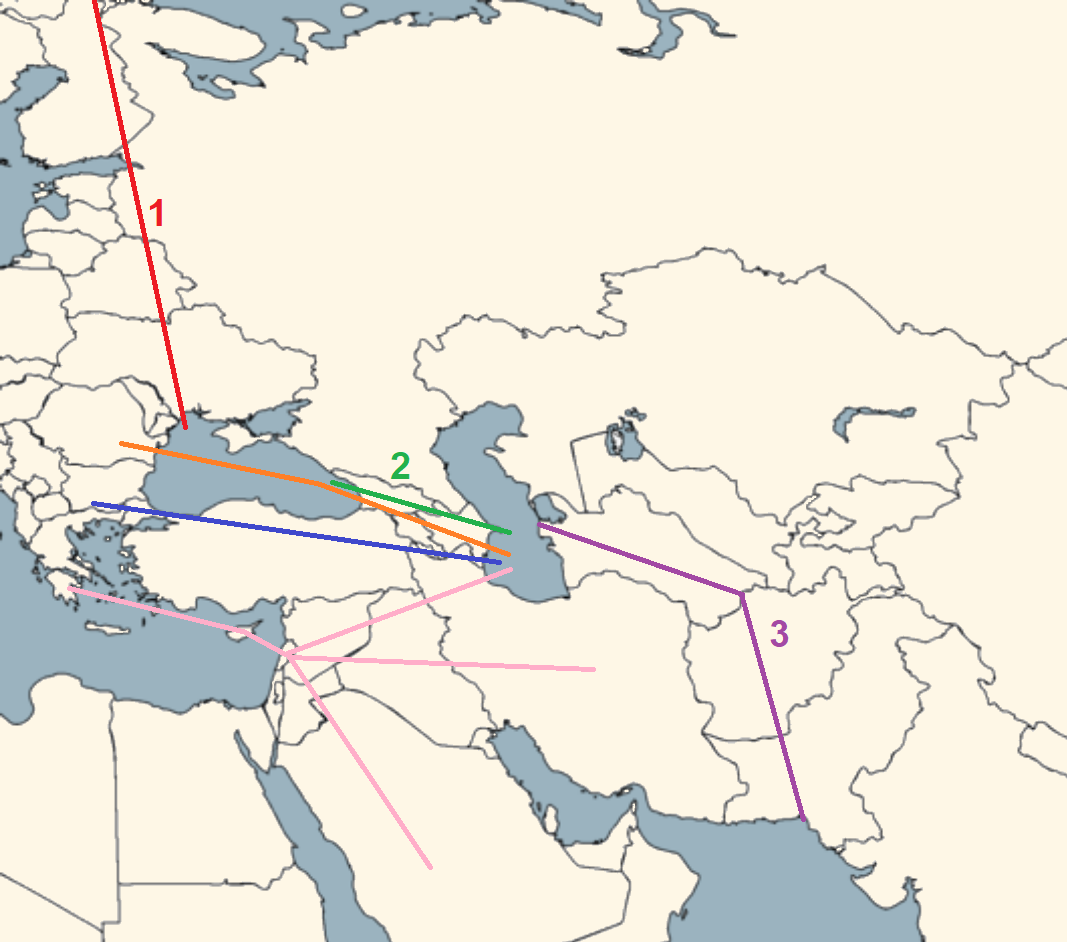
Let’s start with the first line, which is red and labeled as (1). It represents the new Intermarium. Here is an example of a page discussing it, along with an image.

Intermarium in the 21st Century – The Institute of World Politics
This paper was written by Agnes Tycner for IWP 634: Geography and Strategy. Agnes is currently pursuing a graduate degree in Statecraft and International
Its role is to divide Europe and Russia.
Now let’s look at the second line, which is colored green and labeled as (2). It passes through Georgia and Azerbaijan. I don’t think I need to explain what is happening in Georgia regarding the color revolution and American influence to viewers of The Duran, since both Alex and Alexander have already covered this topic well.
Now we come to Azerbaijan and the “Azerbaijan Trump Corridor.”
“The “Azerbaijan Trump Corridor,” officially the Trump Route for International Peace and Prosperity (TRIPP), is a U.S.-brokered transport corridor agreement between Armenia and Azerbaijan. It links mainland Azerbaijan with its Nakhchivan exclave via Armenia, featuring roads, railways, pipelines, and fiber optics. The corridor promises regional peace and trade by providing new East-West transit routes while reducing Russian and Iranian influence, with the U.S. holding development rights for 99 years.”
Now you can see why the West is so interested in Georgia and Azerbaijan.
Now let’s look at the third line, which is colored purple and labeled as (3). It passes through Turkmenistan, Afghanistan, and Pakistan.
Recently, there was a conflict between Pakistan and India, which I discussed in my posts. This war was provoked by the United States, which conducted a terrorist attack in India using our McJihadists, giving India an excuse to attack Pakistan. Many people believe Pakistan won the conflict, but I disagree. I hold the view shared by John Helmer that Pakistan lost and India emerged victorious, and there are even rumors that Pakistan’s nuclear arsenal was damaged.
I think it is the only conflict which Trump really stopped, but don’t give him too much credit — he was behind starting it in the first place. Pakistan was heavily beaten by India and, in desperation, asked Trump to intervene and make India stop its attack. For the first time in history, immediately after this conflict, the military leader of Pakistan — the actual power in the country — visited the White House.
At that time, Pakistan was leaning toward China and getting too close to it. In response, the U.S. created a conflict between India and Pakistan, forcing Pakistan back into the American sphere of influence. If Pakistan had truly “won” the war, as many people claim, why didn’t its leader visit China to toast Xi Jinping and celebrate the achievements of Chinese weapons? Instead, he went to Washington. In reality, Pakistan lost to India and offered itself as a platform and proxy for the U.S., asking Trump to stop the conflict.
Meanwhile Afghanistan began cooperating closely with China and Trump demanded control of Bagram Airfield from Afghanistan. When Afghanistan refused the U.S. then used Pakistan as a proxy against Afghanistan and now we have military actions between Afghanistan and Pakistan. I don’t yet have information on Turkmenistan, but I am confident that America is expanding its influence there and turning the country into a proxy as well.
Now you can see why the West is so interested in Pakistan and Afghanistan, and why these events are unfolding there.
Now let’s look at all three lines — red, green, and purple, labeled (1), (2), and (3).
The red line separates Europe from Russia, while the green and purple lines separate the land corridors connecting Russia and China to the Middle East.
Why is this important? Because if the sea blockade of China begins — as I have been predicting and as Brian Berletic has discussed — land corridors between China and the Middle East must be blocked, and since Russia is an ally of China, land routes connecting Russia to the Middle East must also be cut off. The green and purple lines effectively create a land barrier between China and the Middle East. If the West controls the states along these lines, a naval blockade of China becomes feasible and could potentially starve China of energy.
However, even with this, China would still have access to Russian energy. But Russia — despite being one of the world’s largest energy exporters — is not sufficient to fully meet China’s massive energy demands. Therefore, controlling the regions along the green and purple routes is essential to preventing China from securing direct land access to Middle Eastern resources. Without that control, a sea blockade alone would be ineffective.
If we view the world as a chessboard and factor energy into the analysis, the Western interventions in Pakistan, Afghanistan, Georgia, Azerbaijan — and other states along these routes — begin to make strategic sense.
I live in Europe, so I’m most familiar with Europe, Russia, and the Middle East. There are also other important energy regions — Nigeria in Africa, Venezuela in South America (both in the top 10 oil exporters), and the Cambodia–Vietnam situation in Asia, which I don’t know much about. Recently I also heard that Saudi Arabia deployed troops to Yemen about two weeks ago, but I haven’t found reliable information on that yet. I’m not claiming to understand the entire global chessboard, but I do understand parts of it, which I’ve tried to outline in this post.
I’ve also drawn additional, unnumbered lines to represent possible gas pipeline routes, which I intended to discuss — but this post is already very long, so I’ll leave that for another time. This is why it’s difficult for me to write short posts — everything is interconnected and extremely complex.
Briefly summarized:
- Orange line — pipelines through Azerbaijan, Georgia, and the Black Sea
- Pink lines — the EastMed pipeline and its potential extensions
- Blue line — the most optimal route, but it passes through Turkey. As mentioned in the video attached to this post, the West is trying to sideline Turkey to prevent it from gaining too much power, leverage, and economic benefit from the project.
I hope some readers understood what I’m trying to convey here. Don’t hesitate to ask questions or share information — I’m not all‑knowing. I spend most of my free time trying to understand what’s happening in the world, but it’s difficult for one person to cover everything, especially while working a full‑time job with limited research time.
Thanks to everyone who stuck with me until the end of my post. And, as always…
“Knowledge will make you be free.”
― Socrates
+
“Knowledge isn’t free. You have to pay attention.”
― Richard P. Feynman
=
“Freedom is not free, you need to pay attention.”
― Grzegorz Ochman
“We’ll know our disinformation program is complete when everything the American public believes is false.”
― William J. Casey, Director of the CIA (1981–1987), allegedly spoken during a 1980s cabinet meeting.
The statements, views and opinions expressed in this column are solely those of the author and do not necessarily represent those of this site. This site does not give financial, investment or medical advice.

Thank you very much for this excellent insight.
“The EU is a US colony.” In turn, the United States is a Jewish controlled colony, owned by the Judeo-Federal Reserve Bank.
This is a commendable start.
All dots are out there waiting to be connected. Pray the connections are not made of lies.
Ich finde Ihren Artikel außerordentlich interessant. Ich habe die Übersetzung auf seniora.org gelesen und möchte sagen: Es fühlt sich alles sehr schlüssig an. Mir gefällt vor allem ihr Blickwinkel. Ich war ein Freund von Schröder. Ich war sicher mit der Achse Schröder Putin gibt es für Deutschland und Europa eine lange anhaltend gute Entwicklung. Natürlich sind auch die deutschen bequem geworden. Wir haben die Wiedervereinigung 1989 verkraftet, die Finanzkrise ging auch glimpflich über die Bühne. Selbst Corona haben wir überstanden. Aber die Ukraine werden wir nicht überstehen! Ich habe immer behauptet, Nordstream ist ein Friedensprojekt, sollte es nicht zur Inbetriebnahme… Read more »
I also supported close cooperation between Europe and Russia which would strengthen Europe, and Europe joining BRICS in opposition to America. The issue was Nord Stream, and it was a big mistake Putin made. Like I wrote in my post, I suspected he didn’t want it and did it only because Germany demanded it. I could be wrong, and if Putin really wanted Nord Stream, then he is not as good a person as I thought. Germany had a policy of Mitteleuropa with the goal of economically suppressing Eastern Europe so that it would stay as cheap labor for Germany.… Read more »
It’s good- Covers a whole lot which makes it a difficult, yet worthy read
Yes, the time for naked imperialism is here, because the empire is in free fall
But it’s a dangerous time..
I did use excerpts from it for a report of my own- you were given attribution, of course