

 Grzegorz Ochman
The statements, views and opinions expressed in this column are solely those of the author and do not necessarily represent those of this site. This site does not give financial, investment or medical advice.
I haven’t written in a long time, and I’m sorry. It’s hard for me to stay motivated, and there’s a lot going on, so I spend much of my time just trying to understand what’s happening. I’m also really depressed because I don’t have people knowledgeable enough to discuss these things with. It’s also depressing because I work hard, I know and understand a lot, yet people don’t take me seriously or believe what I write.
Sometimes I feel uplifted — for example, after a long time of me advocating for The Duran to invite Brian Berletic back, they finally did. Or when, after I called John Helmer the G.O.A.T. of geopolitical analysis, he was suddenly invited on the program of The Duran’s friend Glenn Diesen. Here is the show I mentioned:
Things like Glenn Diesen’s show with John Helmer or The Duran’s program with Brian Berletic made me feel like people like Glenn, Alex and Alexander actually read what I write, and that my writing has meaning. But then there are moments, like Alex saying that Radosław Sikorski helped organize the Maidan coup — which, as I explained in my post, is not true — that make me question myself. It makes me wonder whether my writing has any point, whether Glenn, Alex and Alexander take what I write seriously, or even read it at all. And that makes me depressed.
Because of this, I stopped writing for a while. It takes a lot out of me to write these things, and if even Glenn, Alex or Alexander don’t take it seriously or read it, what’s the point?
I know I’m no one. I have no formal education, no achievements, no career, so I am no one and I have no authority. But I really do know and understand a lot. It’s very depressing to know the truth, to see others not knowing it, and to be unable to do anything because no one takes you seriously. Imagine understanding what’s happening better than most people, but being “no one,” and no one taking you seriously. It makes me feel powerless and deeply depressed.
What’s the point of knowing and understanding the truth if you’re “no one” and no one listens? I genuinely want people to know the truth, because only if people understand it can they try to fix what’s happening. If you don’t understand a problem, you can’t fix it.
Okay — let me write a little about Poland and Ukraine. I wrote before about what I see as a coup d’état against Germany in a previous post, so people who follow what I write should know what I’m referring to. I’ll also use Radosław Sikorski as an example, since he is an important figure in this history and because using his case can make things more understandable. I’ve also heard a lot of false things said about him, like Alex and others saying he took part in the Maidan coup d’état, which in my opinion is wrong.
First, let me address the main video attached to this post — it’s also from The Duran’s friend Glenn Diesen with Patrik Baab, a German whose videos I’ve used before. While I don’t agree with everything he says (I don’t fully agree with any single geopolitical analyst), I find some of them — like Brian Berletic and John Helmer — closer to my views. Still, they don’t know or understand what I do.
Also, I don’t want to discredit Alex and Alexander, whom I respect very much. I’ve previously cited things they said that I agree with. For example, I like Alex because I think he’s more open-minded to truths that are far from mainstream, while Alexander sometimes struggles to accept them. Yet Alexander’s understanding of socialism and the real left has been very uplifting for me.
When I first started watching and writing about The Duran, Alexander didn’t advocate for the left or socialism as much as he does now. I can only hope I had a small influence on him, and that he has finally started to speak more like me — in fact, following in the footsteps of his father, whom he himself called left and socialist. In my opinion, he should be proud of that heritage, and now he clearly follows it.
To give an example, I recently saw him again on the video channel of a Chinese woman whose programs I’ve been following, and what he said there about socialism I agreed with 95%. It made me proud of him:
What Alexander said in that program about the fall of the Soviet Union being a victory of the capitalist class against labor, and about globalists being an international capitalist class, was excellent. Globalists and neocons are not communists or socialists — they are a fascist international capitalist class, the complete opposite of socialism and communism. That’s why it angers me when people say the EU or Democrats are socialists — it’s nonsense.
Anyway, I won’t spend more time on that. I often have problems because everything is connected, and when I try to explain something, I jump from one subject to another. If I wanted to fully explain something, it would take hours or many pages, because understanding something isn’t about simply being told how things are — it’s about understanding how they interact. It’s not about being shown “the truth” but understanding why it’s the truth.
In one of my recent posts with a video of comedian Kurt Metzger, where I touch on deeper truths that are hard to accept, he explained this well:
In fact, you’re less reliable nine times out of 10 if you went to school for journalism. That’s how I think you’re not a journalist. So, you’ve already been trained to be a [__] about how you go about it. And you’re trained to not connect this to that. See how I make all these connections and people say, ‘Oh, you’re all over the place.’ No, I’m not. I’m looking at the whole thing and you won’t because you went to school to learn how not to do that. And the things I’m saying are probably upsetting to you. They upset me — but why should I have to know this and you don’t?
Most people are trained not to look at the big picture. Fortunately, I wasn’t. Because of that, I’ve been able to connect different things, which has made me understand what others don’t see.
Anyway, enough of my tangent — let’s go to the main subject.
The Western Capitalist Empire of Evil, Halford John Mackinder’s “World-Island,” and Carl Oglesby’s modern version of the “Yankee and Cowboy War” — the Globalist and Neocon War
Let’s begin with Halford John Mackinder, the father of Western geopolitics. Those who followed his work and understood his Realpolitik worldview included figures like Józef Piłsudski, Henry Kissinger, and Zbigniew Brzezinski, as well as politicians from Poland’s PiS party, such as the late President Lech Kaczyński (R.I.P.), who was himself a follower of Piłsudski. Since Piłsudski followed Mackinder, those who followed Piłsudski also had to understand Mackinder’s ideas.
Here is one of Mackinder’s most famous quotes, which explains much:
Later, in 1919, Mackinder summarised his theory thus:
Who rules Eastern Europe commands the Heartland;
who rules the Heartland commands the World-Island;
who rules the World-Island commands the world.
But what is “Eastern Europe”? It’s essentially Intermarium.
Intermarium (Polish: Międzymorze, Polish pronunciation: [mʲɛnd͡zɨˈmɔʐɛ]) was a post–WWI geopolitical plan conceived by Józef Piłsudski to unite former Polish–Lithuanian Commonwealth lands within a single polity. The plan went through several iterations, some of which anticipated the inclusion of neighbouring states. The proposed multinational polity would have incorporated territories lying between the Baltic, Black, and Adriatic Seas, hence the name Intermarium (Latin for ‘Between-Seas’).
Intermarium – Wikipedia
From Wikipedia, the free encyclopedia Intermarium ( Polish: Międzymorze, Polish pronunciation: [mʲɛnd͡zɨˈmɔʐɛ]) was a post- WWI geopolitical plan conceived by Józef Piłsudski to unite former Polish-Lithuanian Commonwealth lands within a single polity. The plan went through several iterations, some of which anticipated the inclusion of neighbouring states.
This made Eastern Europe — specifically Intermarium, with Poland as its main part — one of the most important regions in the world. Whoever controlled Poland controlled Eastern Europe; whoever controlled Eastern Europe controlled the Heartland; and whoever controlled the Heartland controlled the World-Island and thus could decide the future of the world.
This is explained well in a video by George Friedman, which I have used many times in my posts.
1:08:10
Well, remember the structure of Europe. From St. Petersburg to Rostov, draw a line. To the west of it is the European Peninsula; to the east is Russia. No one has ever permanently occupied Russia, but Russia has always moved westward. Now it’s just further east. The line, incidentally, is roughly the border of the Baltics, Belarus, and Ukraine.
The question on the table for the Russians is: will they retain a buffer zone that’s at least neutral, or will the West penetrate so far into Ukraine that they’re 70 miles away from Stalingrad and 300 miles away from Moscow? For Russia, the status of Ukraine is an existential threat, and the Russians cannot let go. For the United States, in the event that Russia holds on to Ukraine, where will it stop? Therefore, it’s not an accident that General Hodges, who’s been appointed to be blamed for all of this, is talking about prepositioning troops in Romania, Bulgaria, Poland, and the Baltics. This is the Intermarium, from the Black Sea to the Baltic, that Piłsudski dreamt of. This is the solution for the United States.
The issue to which we don’t have the answer is: what will Germany do? So the real wild card in Europe is that as the United States builds this cordon sanitaire—not in Ukraine, but to the west—and the Russians try to figure out how to leverage the Ukrainians out, we don’t know the German position. Germany is in a very peculiar position. Its former Chancellor, Gerhard Schröder, is on the board of Gazprom. They have a very complex relationship with the Russians. The Germans themselves don’t know what to do. They must export. The Russians can’t take up the export. On the other hand, if they lose the free trade zone, they need to build something different.
For the United States, the primordial fear is Russian capital, I mean German technology and German capital, Russian natural resources, and Russian manpower. This is the only combination that has for centuries scared the hell out of the United States. So how does this play out? Well, the U.S. has already put cards on the table: it is the line from the Baltics to the Black Sea. For the Russians, their cards have always been on the table: they must have at least a neutral Ukraine, not a pro-Western Ukraine. But the outcome is another question.
Whoever can tell me what the Germans are going to do is going to tell me about the next 20 years of history, but unfortunately, the Germans haven’t made up their mind. And this is the problem of Germany always: enormously economically powerful, geopolitically very fragile, and never quite knowing how to reconcile the two.
Therefore, my country, Poland, became a battleground between the German Deep State and the American Deep State — what I have previously described in my posts as a struggle between German Globalists and American Neocons. This story is long, and I’ve explained parts of it before in my earlier posts, so I won’t go too deeply into it here; otherwise, this post would be about 100 pages long.
In short, Poland defeated communism with the Solidarity movement — which, in my view, was the original Western “color revolution” — with the help of the CIA, the Vatican, and the Christian Church. The Polish national myth says Pope John Paul II, a Polish pope, was a hero and a good man, but I know and understand a different truth.
The Vatican, the Christian Church, and elements of the Western Deep State (including the CIA) were intertwined. For example, “in 1956 Cardinal Spellman ordained one Avery Dulles — John Foster Dulles’s son and Allen Dulles’s nephew — as a Catholic priest and later future cardinal,” showing a clear connection between the CIA, the Vatican, and the Christian Church. The Vatican also helped Nazi criminals escape justice after World War II, which ties into the ongoing scandals of pedophilia in the Christian Church.
Pope Benedict XVI, the right-hand man of Pope John Paul II, was once in the Hitler Youth and was responsible for covering up many cases of pedophilia in the Church — a sign of what the Vatican and the Christian Church truly represent. Here is an important excerpt illustrating what I mean:
According to Gene Pope Jr., Cohn’s childhood friend, Cardinal Spellman was a critical power broker in mid-century New York, claiming he had the ultimate say in appointments to bureaucratic roles in city government. Rumors also circulated that Spellman was secretly gay, as noted by his biographer John Cooney. His homosexuality was considered an open secret, with rumors of him seducing young altar boys and claims that he favored certain young priests. Spellman allegedly bragged about his ability to procure young boys from his diocese and openly flaunted his homosexual escapades. His proclivity for homosexual relations was shared by his future lawyer and fellow New York power broker, Roy Cohn.
By the way, this is the same Roy Cohn — the gay, Jewish mobster and blackmailer — who was the mentor of our “lovely” Trump. This explains Trump’s connection to Epstein, who was essentially doing the same things as Trump’s mentor, Roy Cohn.
Again, I’ve gone off topic, but you can see how everything is connected. Going back to the main subject: after Poland defeated the Soviet Union with Solidarity — the original “color revolution,” backed by the CIA and the Vatican (both of which were full of criminals and pedophiles) — Poland ended up with a “leftist” government that was, in reality, controlled by the German Deep State, which at the time was working with the American Deep State.
After this, Poland was plundered and destroyed by neoliberal “shock therapy” imposed by Jeffrey Sachs, whom Michael Hudson aptly called the “Butcher of Yugoslavia.” The same fate was planned for Russia, using the World Economic Forum’s Young Global Leaders program and its protégé, Vladimir Putin, who, to gain the trust of Western oligarchs, helped them plunder Saint Petersburg.
This is why I call the German Deep State “Globalists” and the American Deep State “Neocons.” Merkel and Putin were both groomed in the WEF’s Young Global Leaders program, representing the globalists, while on the other side you had the American Neocons — the people behind The Project for the New American Century (PNAC) group.
You could say it was a fight between the WEF and PNAC. PNAC, full of American Neocons, wanted full-spectrum dominance of America over the world using military force, while the WEF wanted to control the world through international organizations like the UN, WTO, World Bank, and WHO.
This reminds me very much of Carl Oglesby’s story of the “Cowboys and Yankees.”
11:09
By “Yankee,” I’m trying to indicate, as would be obvious from the word itself, the Eastern establishment multinational monopoly capitalist formations personified in the empire of the Rockefellers. David Rockefeller is, from this standpoint, the archetypal Yankee. The Yankee perspective is complex, tortured, and constantly in the process of reformation. I don’t like having to oversimplify its complexity, but it may be possible and fair to produce the following generalization: the Yankee stands on the East Coast and relates to Europe as if it were the opposite side of a lake, a medium for communication and transportation. The Yankee worldview, Anglophilic and rooted in the belief in a special relationship between the United States and Britain, imagines the center of the world as a North Atlantic industrial community that came into being roughly in this century, traumatized and molded by several world wars. That world center, at least from its own standpoint, is historically, traditionally, and currently the domain of interest of the Yankee sensibility. The multinational corporation, which moves through this as its capital sphere, is the primary mode of economic organization of this class.
The monopoly capitalist class has several characteristics that differentiate it from another class: the class of modern cowboy entrepreneurs. Entrepreneurial capitalism, or cowboy capitalism, grew up in the United States, particularly because the country developed with a frontier that was constantly in motion. When Marx analyzed 19th-century societies and derived the basic conceptions of class that Marxists still employ today, he was dealing with countries that had essentially fixed boundaries—top, bottom, left, and right. This was not entirely true in detail, as there were plenty of boundary disputes during that period and beyond, which remain significant in contemporary European affairs. However, what was distinctive about the United States was its unique boundary, one that extended beyond Western civilization itself—a boundary into an outside world. The white man, as a conqueror of the Western tradition, moving across the Atlantic to this country during a period of exploration and colonization, saw this world as unquestionably his to dominate, exploit, and make his own in ever deeper and, some would say, more horrifying ways as the spectacle of industrial civilization rolled over that mythic Indian past, which to many of us today seems an infinitely preferable alternative.
In any case, the movement of the frontier throughout the history of the United States meant there was always an escape hatch, so to speak. There was always a way to avoid coming into conflict in the big cities over issues that were thus constantly suspended. There was always enough to go around, so the normal social adversaries that would typically be in sharp conflict, as in Europe—producing a viable socialist tradition there—turned to the West in this country.
56:41
The continued relationships and entanglements in Europe see America as a liberated land where democracy and capitalism happily coexist, but only on the condition that the frontier keeps moving, that we keep expanding the world space available to our enterprise, to entrepreneurs like Howard Hughes, H.L. Hunt, or Getty—Southwestern moguls and entrepreneurial capitalists who are much wealthier as individuals than their Yankee counterparts but command nothing like the empires of Yankee scope. For example, Howard Hughes is said to be worth three or four billion dollars, while David Rockefeller is worth only a few hundred million. However, the empire Hughes sits on ends with him at that four billion, whereas the empire David Rockefeller sits on might extend to 400 billion or more—who knows, really? This stepwise disparity in relationships gives a sense of the interstices where the cowboy-Yankee conflict or gunplay takes place. We have an individual cowboy like Hughes with enormous personal leverage up against a highly institutionalized power center like the Rockefellers, where individuals have little room for maneuver. The main job of captaincy in such a system is to keep the vast linkage of institutions moving together in some rational way. Hughes, for example, doesn’t have that problem—he’s an entrepreneur, not a monopolist.
The frontier made it possible for entrepreneurs to amass fortunes like four billion dollars because it constantly recreated the conditions in which entrepreneurial styles of individual initiative capitalism flourished. Following behind were the railroads, the Hammonds, the Yankees, who would come after and assimilate these small personal empires into larger ones, providing modern-style rationalization—technological, administrative, and so forth. The cowboys would keep moving away from them, out into new, clear wilderness, into land where nobody lives—because the Indians aren’t considered people, the Hawaiians aren’t people, and at certain points, the Filipinos, the Chinese, the Koreans, and the Vietnamese aren’t either. These “reds” are like the “redskins” of old, serving the same purpose: they bow to our genocidal needs, giving us space and a sense of righteousness, using opportunities seen as manifest destiny in all kinds of signs.
But now that very process, whatever one makes of it, was coming under fundamental challenge with the victory of the Chinese Revolution, which closes—probably the real meaning of this century—the door once and for all on Western culture’s movement into dominant relationships over Eastern cultures. That’s really what’s behind Korea. Our effort in the Korean War was to keep that door open somehow by maintaining a place where we could outweigh the Chinese “monstrosity.” When that failed, it broke out in Vietnam, and we had to fight it all over again. How many times would it have to be fought? How many exasperations would a cowboy mind have to endure? The bombings visited upon Southeast Asia were not due to some impenetrable psychological problem of Nixon’s; they were carried out because of the political configuration at the time, as the people who ran the country saw it. They moved to fight the war because they wanted it, not because they drifted or stumbled. The cowboys wanted the war because they believed that without America maintaining that kind of position in an open-door world to the East, the traditional ways would have to change. And maybe they were right—maybe when that frontier closes, the traditional ways will indeed have to change, and perhaps that’s precisely the kind of question confronting us.
1:11:39
Cowboy Hughes and Rockefeller are interesting, especially because they vividly embody the forces of monopoly versus modern entrepreneurialism, which I’ve been trying to describe. This huge story is broad, novelistic, and interesting, and I’ll never do it justice, but I want to capture a few essentials to get the curve of it right. In the 1920s and 1930s, during the early part of this century’s industrialization, Hughes, with the foresight of a prophet, understood the indications of industrial development over the next decade. He saw, in particular, the importance of trans-oceanic communications and, among many other projects, got involved in the effort to build the 747. It was too early—he didn’t have the metallurgy or the engines, and people laughed, calling it the Spruce Goose. But Hughes knew such things would be necessary, partly because he saw America emerging as a world empire, confronted on all sides with problems that would require sending troops worldwide. With only a few hundred million Americans compared to billions of others, Hughes figured there had to be a way to technologically multiply the power of the few Americans to endure in their struggle against “the others”—really, the whites against the others. That’s why he tried to build the Spruce Goose, that huge plywood seaplane that, in 1947, got about 100 feet off the water.
This airplane holds more than usual importance in the story of Yankee and cowboy because, in 1947, Senator Owen Brewster of Maine revealed that Hughes, along with others, had profited enormously from wartime contracts, including those for the Spruce Goose. Brewster began harassing Hughes, throwing around figures about how much money Hughes had supposedly ripped off the country by building airplanes that never made it to war, weren’t finished by the war’s end, and, years later, were still not at prototype levels. This happened to others too, but Hughes was vulnerable, and Brewster attacked him publicly, eventually bringing him before a Senate investigating committee with reporters and bright lights. Hughes didn’t want to go—he never liked public appearances, and this period marks when he soured on them entirely. At Brewster’s Senate hearing, Hughes heard the charges and said to a national audience, “What’s really behind this?” He claimed Brewster was trying to coerce him into aligning TWA with the Rockefeller powers, who had long been pressuring him to join them. Hughes said the only reason Brewster was calling him out was because, two weeks earlier, Brewster had told him the hearings could be avoided if Hughes went along with the Juan Trippe plan for TWA.
At the end of World War II, the Yankee custodians of European reconstruction decided that European countries’ airlines would be cartelized—each country would have one overseas airline, not internal ones. They wanted an American counterpart, likely believing it was the only way to compete with foreign airlines. To make this happen, they wanted Hughes’ TWA to merge with Pan American and any other overseas carriers. Hughes saw this for what it was: an outright attempt by the Rockefellers to gain monopoly control over international airways. He felt there was no reason for this, as he had pioneered the concept of international airways himself. When he pointed this out publicly to Brewster, the senator collapsed, unable to run for Senate again. Hughes, with his sloppy, lanky frame and no tie, became a sort of popular figure—four billion dollars’ worth of popular, though images can hide a lot. This beat back the Yankee Rockefeller attempt to assimilate Hughes’ holdings into their highly rationalized monopoly empire.
But by the time jets arrived in the 1950s and 1960s, the fight broke out again in a more complicated and earnest way, involving massive, lengthy court battles too complex to detail impromptu. The upshot was that a group of Yankee bankers wanted TWA, and when TWA became vulnerable with the advent of jets, Hughes could have bought the jets and necessary facilities out of the pocket of Hughes Tool Company. However, Hughes Tool Company was tied to Hughes Aircraft, and antitrust regulations—written by Rockefeller types to suit the needs of monopoly capitalists, not entrepreneurs—made it illegal for someone in one aviation sector, like manufacturing, to operate in another, like airlines. So Hughes couldn’t transfer his entrepreneurial money from one pocket to another. This led to an enormous, prolonged fight, resolved around 1966, when Hughes was forced to sell TWA, leaving him much more exposed. An enormous check, perhaps $486 million, was written for his TWA shares.
At this point, Hughes seemed to ask himself how to continue the fight against the Rockefellers after being beaten out of his airline. Could he reconstitute, reorganize, or build another industrial empire? He came to Boston in 1966 to think it through. It was quite a scene, lasting a few months, with reporters banging on doors and trying to get a picture of the elusive Hughes, who was becoming increasingly secretive. Amid this chaos, he decided he couldn’t rebuild his industrial empire from scratch with oil or airplanes. He needed to buy an already-built empire and chose Meyer Lansky’s. In Boston, he debated whether to go to the Bahamas or Las Vegas with his $486 million. Initially considering the Bahamas, he ultimately chose Las Vegas in November 1966, setting himself up in a casino inn that his man, Robert Maheu, had bought the night before from the syndicate.
Through Maheu, Hughes established a situation in Las Vegas that neutralized the syndicate’s usual hostility toward newcomers. He convinced Lansky and others that he was good for Las Vegas, bringing legitimacy, glamour, and new people to town. For four years, through November 1972, Hughes built a political empire on the base of this gradually acquired casino and hotel industry, linking him to key regional politicians, including Dick Nixon. The exact nature of Hughes’ relationship with Nixon during the Las Vegas period must be understood in light of Nixon being Lansky’s man. When Hughes tried to “buy” Nixon, he was dealing with someone already bought. This is why the $100,000 delivered from Hughes’ people to Bebe Rebozo in 1969 or 1970 was so sensitive. Hughes was giving money that Lansky wouldn’t know about, and Rebozo couldn’t hide it because the usual hiding places belonged to Lansky’s system. If that money entered the “laundry,” it would be discovered by those Nixon and Hughes were trying to keep it secret from. This is speculative, but looking at the evidence, it’s hard to explain why they were so touchy about the Rebozo money when $150,000 flowed freely to Nixon via the “overland route” during that time. It’s the underhanded money, buying special “dark pool” privileges, that sparked all the curiosity and fuss.
Again, I’ve drifted off topic, but it’s all connected — and these fragments should help you understand what I mean by “Globalists vs. Neocons,” a modern version of “Yankees vs. Cowboys.”
Globalists — represented by the WEF, the WTO, and other international organizations — are monopolist capitalists led by people like Klaus Schwab, a modern-day equivalent of the Rockefellers and their empire. On the other side are the PNAC Neocons, represented by entrepreneurial figures like Elon Musk and Peter Thiel.
The key difference today is that the old “Yankees” empire so the Globalists moved their power base to Europe with the WEF, while the “Cowboys” took over America represented by Neocons and the PNAC project.
This fragment is very important:
But now that very process, whatever one makes of it, was coming under fundamental challenge with the victory of the Chinese Revolution, which closes — probably the real meaning of this century — the door once and for all on Western culture’s movement into dominant relationships over Eastern cultures.
While the Chinese Revolution closed that door, the fall of the Soviet Union opened it again. Now the new “Cowboys,” in the form of the Neocons who fully controlled America, saw that the door was open and wrote The Project for the New American Century (PNAC) — their plan for full-spectrum dominance, designed to re-enter “Western culture’s movement into dominant relationships over Eastern cultures” and to destabilize and dominate the whole world, starting with the Middle East.
This is connected to “A Clean Break: A New Strategy for Securing the Realm,” written for Israel. The “Cowboys” have always been connected to military power and Western dominance over the world, as Carl Oglesby explained in the quote I cited earlier. The Chinese Revolution stopped their plans, but the fall of the Soviet Union reopened the door.
The PNAC project and Israel’s “A Clean Break” were the plans of the modern “Cowboys” — the Neocons — to control the world. But there were also the WEF Globalists, the modern version of the “Yankees,” who sought to control the world not through full-spectrum military dominance like the Neocons, but through international organizations such as the WTO, World Bank, WHO, and others.
Thus, the modern “Yankees” — the Globalists — were mostly in Europe, while the modern “Cowboys” — the Neocons — were mostly in America. While the modern “Cowboys” (the PNAC Neocons) wanted to start wars in the Middle East, the modern “Yankees” (the WEF Globalists) wanted to control the world through international institutions.
While the Neocons groomed George W. Bush in America to launch wars in Afghanistan and Iraq, the Globalists groomed Merkel and Putin in Europe. This created a deep divide between America and Europe, with Poland as one of the main battlegrounds.
Poland, the War in Ukraine, and the Truth: A Coup d’État Against Germany
The war in Ukraine is part of the struggle between the modern “Cowboys” — the Neocons from PNAC — and the modern “Yankees” — the Globalists from the WEF. This battle played out in Poland.
At first, they worked together to destroy the Soviet Union, which they achieved using Poland and the Solidarity movement. After that victory, the American Neocons wrote The Project for the New American Century (PNAC), alongside Israel’s A Clean Break: A New Strategy for Securing the Realm, both of which were blueprints for full-spectrum dominance through military power. In other words, they wanted to use the newly reopened “door” for “Western culture’s movement into dominant relationships over Eastern cultures.”
The European Globalists of the WEF didn’t like this. That’s why most European countries refused to join the second war in Iraq, something that alarmed the American Neocons (as mentioned in the main video attached to this post). The WEF had its own groomed leaders in the form of Merkel and Putin, who were positioned to oppose the Neocons.
Originally, Putin was groomed to oversee the destruction and plunder of Russia, just as Poland had been plundered. This is why the Neocons initially supported Putin’s rise to power — they believed he would allow Russia to be looted by Western interests. But instead, Putin turned against them and refused to let Russia be plundered. While this angered the Neocons in America, the European Globalists saw in Putin someone they could cooperate with against U.S. dominance. Since Globalists intended to control the world through the UN, WTO, WHO, and other institutions, they could still achieve influence over Russia through international structures. The Neocons, however, hated this because their vision of full-spectrum dominance required Russia to be completely subordinated.
The Globalists understood they needed cooperation from both Russia and China to oppose American Neocons, who wanted to dominate not only the West but the entire world. European Globalists controlled international organizations, while the American Neocons wanted absolute dominance outside of any international framework. You cannot have “full-spectrum dominance” if you’re constrained by the UN or international law. To achieve it, you need a “rules-based order” — rules made and enforced by yourself.
The Globalists in Europe might have won if not for their own greed. Their main base was Germany. Although the European Union was created with the help of American Neocons, Globalists convinced them that the EU would help control Europe. In reality, the Globalists seized control of the EU and turned it into a neo-colonial project for Germany to dominate the continent. With control over Europe and cooperation with Russia and China, Germany and the European Globalists could have challenged American Neocon dominance.
The Neocons realized this and turned to Intermarium, as George Friedman said in quote I mentioned earlier:
This is the Intermarium, from the Black Sea to the Baltic, that Piłsudski dreamt of. This is the solution for the United States.
Germany’s oppression of Poland’s economy — keeping it weak, poor, and reduced to the role of cheap labor — had already created deep resentment. Germany’s Globalist vision was not of an equal, solidarity-based European Union, but of a hierarchical order where Germany dominated and Eastern Europeans were treated as second-class “Untermensch.” This arrogance doomed their project. Resentment grew across Eastern and Southern Europe.
That is why I described Ukraine as a coup d’état against Germany. The American Neocons saw that resentment and decided to use it. Poland was the most important piece on the board — the main country of the Heartland, the Intermarium.
At first, Poland’s left-wing governments were puppets of Germany. Since Poland was closer to Germany, and Germany was a base of European Globalists, they initially controlled Poland. But then the American Neocons supported the Polish PiS Party. The PiS were good students of Realpolitik, familiar with Mackinder’s theories via Józef Piłsudski, and they understood the importance of the Heartland and Intermarium. The Americans told them: “We have a plan to divide Germany and Russia. This will weaken Germany and give Poland a chance to free itself from German oppression.”
But since Germany, Poland, and America were all in NATO — at least on paper — America could not openly attack Germany. So they needed another way to divide Germany and Russia, weakening Germany indirectly while maintaining the appearance of alliance. That plan became Project Ukraine.
I explained before that Poland was too weak to carry out this project alone with the Americans. They needed support from other European countries. Norway and Denmark joined because Germany’s dependence on cheap Russian gas undermined them, as they were the main gas producers in Europe. If Germany had accommodated their gas exports, they would not have supported Project Ukraine. France also had grievances: Germany undermined French nuclear power, overregulating it and denying it “green energy” status in order to keep France reliant on Russian gas routed through Germany. Germany’s strategy was to make all of Europe dependent on Russian gas distributed by Germany, which would give it immense leverage.
Germany sabotaged any alternative gas projects and worked to cripple French nuclear energy. This greedy, short-sighted approach alienated other countries, who began to resent German dominance. Their vision of an “independent Europe” under German leadership collapsed, because no country wanted to swap U.S. domination for German domination.
The Americans, however, didn’t care who dominated Europe as long as Europe stayed subordinate to Washington. So when they saw an opportunity to weaken both Germany and Russia, they seized it through Project Ukraine. The goal was not primarily to destroy Russia (though the Neocons would have been happy with that outcome), but to destroy German-Russian cooperation, which underpinned the European Globalists’ power.
The genius of the Neocon plan was that they would benefit no matter what happened. If Russia lost, they could plunder it. If Russia survived, German-Russian cooperation would be broken, and Europe would be too weak to oppose U.S. dominance. Either way, the Globalist project of a German-led Europe independent from the U.S. was stopped.
Other European countries supported Project Ukraine despite knowing it would weaken Europe, because it would also weaken Germany and end its oppressive dominance over them. For countries like Poland, Denmark, Norway, and even France, this trade-off seemed worth it.
This also explains Trump’s position: he could oppose the war against Russia while still supporting the sabotage of Nord Stream. The real target was Germany, not just Russia. The war’s main goal was to destroy Germany’s neo-colonial project in Europe led by the Globalists.
Neocons like Trump still wanted full-spectrum dominance, so they supported Ukraine tying down Russia’s resources. With Russia bogged down, the U.S. could act elsewhere, like Syria or Iran. If Russia were free of Ukraine, it could send large amounts of weapons — S-300s, S-400s, S-500s, and more — to allies like Iran. But with Ukraine threatening Russian assets, Moscow needs those weapons at home. This is why the U.S. even wanted to bleed Ukraine indefinitely — not to “win,” but to keep Russia tied down.
Russia is strong, but it is not an all-powerful superpower. People go from one extreme to another: mainstream media paints Russia as weak, while some alternative voices paint it as invincible. The truth is more complex. Even Russians admit they are taking heavy casualties, sometimes more than Ukraine, because they are on the offensive. Yet many refuse to accept this. I’ve tried to explain before, but people reacted badly when I pointed out these realities, even when I cited Russian sources.
This kind of black-and-white thinking is disappointing. Reality is much more nuanced. Anyway, I’ve gone off topic again, so I’ll stop here.
The Person of Radosław Sikorski
I want to share a recent video by John Helmer. While it is interesting, I don’t agree with everything he says. However, it does include a mention of Radosław Sikorski.
1:38:58
What I’ve already published is the Sikorski ploy. Chrystia Freeland’s two friends, among many, are Applebaum and Radosław Sikorski. Sikorski is currently the foreign minister of Poland, but since his party’s defeat in the presidential election last June, he wants to be prime minister of Poland. This is after being booted out of Polish politics some time back and kept in exile by the previous government. Sikorski and Applebaum will be telling Freeland to bide her time, build an international profile, and conceal the money sources. In Sikorski’s case, he’s the German money candidate to be prime minister of Poland. He’s already signaled this by abandoning his own government’s commitment to pursuing and improving the reparations payments that Germany owes Poland for the destruction it wrought between 1939 and 1945. Sikorski is the German candidate to be prime minister of Poland, his long-term ambition.
I wrote that I was disappointed when Alex said that Sikorski took part in the Maidan coup d’état, because I had already explained that this is not true. I also heard many analysts repeat the same claim — that Sikorski was involved in the Maidan coup d’état — which is wrong, as I have explained before. I felt really disappointed and even depressed when Alex said it, because it made me think that he either didn’t read what I wrote or didn’t believe me. Let me explain.
Sikorski first became foreign minister of Poland in the PiS government, which was aligned with American Neocons against the German Globalists. Although Sikorski himself was more sympathetic to the German Globalists, he was working for a government that cooperated with the American Neocons against them. That is why he helped to engineer Project Ukraine on behalf of the PiS government and the American Neocons, even if he was personally against it. Since he was working under leaders aligned with the American Neocons, he carried out their agenda even if it went against his own preferences. The earliest reference to Sikorski’s role that I found was from Professor Stephen F. Cohen.
1:01:24
In 2008, the Bush administration tried to fast-track Georgia and Ukraine into NATO, but it was vetoed by Germany and France. So, a guy in Poland who became foreign minister, named Sikorski, dreamt up, with Carl Bildt, the former foreign minister of a Scandinavian country, the so-called Eastern Partnership. Instead of bringing them into NATO, they would offer these wonderful partnerships that would integrate them into Europe as part of the European free market, with free visa travel, etc. Clearly, it was meant to eventually erode NATO membership. The Russians did not object to that; they just objected to the trade terms because they said Ukraine was their largest trading partner and vice versa, with an enormous trading relationship built over centuries. If Europe’s goods were to flow through Ukraine without customs into Russian markets, their producers would be destroyed. This had to be negotiated, but the European Union absolutely refused to negotiate with Russia on this for two years. So, Putin then said, OK, let’s make this a tripartite arrangement—a trade partnership between Russia, Ukraine, Kiev, and the European Union. He was told to take a walk.
Now, look at the partnership agreement that the elected president of Ukraine—corrupt, but elected—refused to sign in November 2013, which set off the protests that led to the Maidan. That agreement was 1,000 pages. I didn’t read all 1,000 pages, but a person I know said to read seven pages buried at the end. In that agreement, which Yanukovych was supposed to sign and was allegedly only about economics, it was the world’s worst economic deal. It would have cost Ukraine, already impoverished, billions of dollars and given it nothing until it went through the austerity program that has brought Greece to its knees. But if the Ukrainian people wanted to do that, good luck—it hasn’t worked anywhere, but if they wanted to try. Buried in those seven pages was a section called military security issues. NATO was not mentioned, but by signing this agreement, Ukraine agreed to abide by the military security policies of the European Union. What are the military security policies of the European Union? NATO. Any lawyer would have picked that up quickly. Russia has a lot of good lawyers, and they were on this. That was never reported in the American press. But the fact is, Yanukovych refused to sign that agreement, which would have meant that if NATO decided something, Ukraine would have to comply. Russia knew about this.
So here we see that Sikorski did help engineer Project Ukraine, but later he was privately recorded saying:
You know, the Polish-American alliance is worthless. In fact, it’s harmful, because it gives Poland a false sense of security. [. . .] Total bullshit. We’ll come into conflict with Germany and Russia, and we’ll think that everything is cool because we gave the Americans a blowjob. Suckers. Absolute suckers.
This shows that he was opposed to the Ukraine project. By the way, those secret recordings were full of gems; for example, Sikorski also said:
In another exchange, Sikorski says of British Prime Minister David Cameron that “he fucked up the Fiscal Compact” and “is incompetent in European affairs,” while offering a frank and obscenity-laced analysis of the United Kingdom’s general engagement in the European Union.
These were private discussions with friends from the government in a restaurant, which had been wiretapped. Here, we see his frank remarks and what he really thinks, not statements made as part of the government. This shows that he was on the side of the German Globalists against the American Neocons, who were planning Project Ukraine to undermine Germany and the German Globalists.
Now, let’s return to what John Helmer said:
In Sikorski’s case, he’s the German money candidate to be prime minister of Poland.
Germany’s Globalists, particularly Merkel’s faction, were opposed to Project Ukraine. Next, let’s examine Sikorski’s role during the Maidan coup d’état, where we find another revealing example of his actions.
Polish foreign minister Radoslaw Sikorski was overheard warning a member of the Ukrainian opposition that President Yanukovich would impose martial law if protesters did not support a deal with the government
Mr Sikorski was caught on camera telling a protest leader: “If you don’t support this [deal] you’ll have martial law, you’ll have the army. You will all be dead.”
When asked by ITV News whether he thought he had managed to persuade the opposition, Mr Sikorski appeared to reply: “I don’t know.”
I have used this video before, and if Alex had read my post or taken it seriously, how could he claim that Sikorski was supporting the Maidan coup d’état? Here, we see Sikorski clearly frustrated, telling Nazi Bandera protesters to stop protesting, go home, and accept a deal with the pro-Russian Yanukovich. If those Bandera protesters had listened to him, agreed to the deal, and stopped protesting, they would not have been able to shoot people and cause the Maidan massacre. So how can it be said that he was supporting the Maidan coup d’état when he was actually demanding actions that would have prevented the massacre?
We have his recordings criticizing the American alliance as “stupid” and showing his willingness to go against America, while the CIA and American operatives were organizing Bandera Nazis on Maidan to provoke violence. At that time, Sikorski was working for Merkel and the German Globalists, trying to stop the Ukraine project — the same project he had helped engineer while serving in the PiS government.
He was foreign minister in the pro-American Neocon PiS government, and later, when this government was replaced by the German Globalist puppet government of PO, he remained foreign minister. During that period, the PO government supported by German Globalists was in power, and Sikorski was working for Merkel to prevent the Maidan coup. While Victoria Nuland was distributing cookies to Bandera Nazis preparing a massacre that would lead to a coup, Sikorski was threatening those same protesters, telling them to accept the deal with Yanukovich, stop protesting, and go home — warning that they would die if they refused.
Sikorski knew that Nuland was preparing the Nazis to shoot people and trigger a coup because he himself had previously helped engineer the project for the PiS government. At that time, he was serving the German Globalists under Merkel, and he understood that if Nuland’s plan succeeded, it would harm his German Globalist masters. Despite his efforts, he failed, and the American Neocons were able to execute the Maidan massacre and carry out the coup.
Later, Merkel attempted to salvage the situation with the Minsk agreements to preserve German-Russian cooperation. However, a year later, the pro-American Neocon PiS government returned to power in Poland, disrupting the German Globalists’ and Merkel’s plans to halt Project Ukraine. With the pro-American Neocon government in power, American Neocons had a free hand to advance the Ukraine project.
Two years after the Maidan coup d’état, in 2016, Poland began work on the Baltic Pipe project, transporting natural gas from the North Sea to Poland via Denmark.
Baltic Pipe – Wikipedia
The Baltic Pipe is a natural gas pipeline between Europipe II (which traverses the North Sea between Norway and Germany) and Poland. It is a strategic infrastructure project to create a new European gas supply corridor. The Baltic Pipe transports natural gas from the North Sea to Poland via Denmark at up to 10 billion cubic metres (350 billion cubic feet) per year.
This was in preparation for the destruction of Nord Stream. The PiS government was informed by the American Neocons of their plan to stop Nord Stream, so Poland began preparing. Preparations had actually started much earlier; during the first pro-American Neocon PiS government in 2006, Poland began discussions about a gas port in Świnoujście.
Świnoujście LNG terminal – Wikipedia
The Świnoujście LNG terminal (also referred as Terminal LNG in Świnoujście, Polskie LNG Baltic LNG, or gazoport) is a liquefied natural gas (LNG) import terminal at Świnoujście, in the extreme north-west of Poland near the Polish-German border. The LNG terminal was operated by Polskie LNG S.A.
This is why Trump is bragging that he stopped Nord Stream, because that was the main goal of the war in Ukraine. Germany was planning to use Russian gas not only as a driver of its economy but also as leverage to exert control over other countries. There was already a Yamal–Europe pipeline in place before Nord Stream.
Yamal-Europe pipeline – Wikipedia
Yamal-Europe pipeline Country Russia, Belarus, Poland General direction north-southwest From Bovanenkovo gas field and Novy Urengoy Passes through Vuktyl, Ukhta, Gryazovets, Torzhok, Smolensk, Minsk, Zambrów, Włocławek, Poznań To Górzyca Runs alongside Northern Lights pipeline (partly) Type natural gas Partners Gazprom PGNiG Gas-Trading S.A.
The construction of Nord Stream was a way for Germany to exert control over Eastern European countries, including Poland. There were absurd situations in which the Yamal–Europe pipeline ran through Poland, yet Poland was forced to buy gas from Germany via Nord Stream because Russia had stopped the flow of gas through the Yamal–Europe pipeline. So even though a pipeline carrying Russian gas crossed Polish territory, Poland was compelled to purchase gas from Germany through Nord Stream and pay transit fees to the Germans. That was the purpose of Nord Stream, as Sikorski stated:
In April 2006, Radosław Sikorski, then Poland’s defense minister, compared the project to the infamous 1939 Nazi–Soviet Molotov–Ribbentrop Pact.[130] In his book The New Cold War: Putin’s Russia and the Threat to the West, published in 2008, Edward Lucas stated, “though Nord Stream’s backers insist that the project is business pure and simple, this would be easier to believe if it were more transparent”
This was back when Sikorski was working for the PiS pro-American Neocon government, before he was co-opted by the German Globalists and Merkel’s faction and changed his stance. This project was opposed by all Eastern European countries, all countries with a Baltic coastline, and the United States.
These Nord Stream projects have faced opposition from some Central and Eastern European countries, as well as the United States, due to concerns that the pipelines would increase Russia’s influence in Europe and result in a reduction of transit fees for the use of existing pipelines in Central and Eastern European countries.
But Germany didn’t care and built it anyway, which symbolizes German pseudo-fairness and solidarity in Europe. There are many examples of Germany oppressing Eastern Europe, because it was not supposed to develop. Instead, Germany wanted Eastern Europe to remain underdeveloped so it could continue serving as a cheap labor force. Industry was deliberately structured to keep Eastern Europe underdeveloped. Just look at the economic crises and Germany’s treatment of Greece, which similarly demonstrates German pseudo-fairness and solidarity — like in Eastern Europe, Greece was treated as Untermensch, serving and benefiting Germany.
Now, the most famous Sikorski gem: “Thank you, USA.”
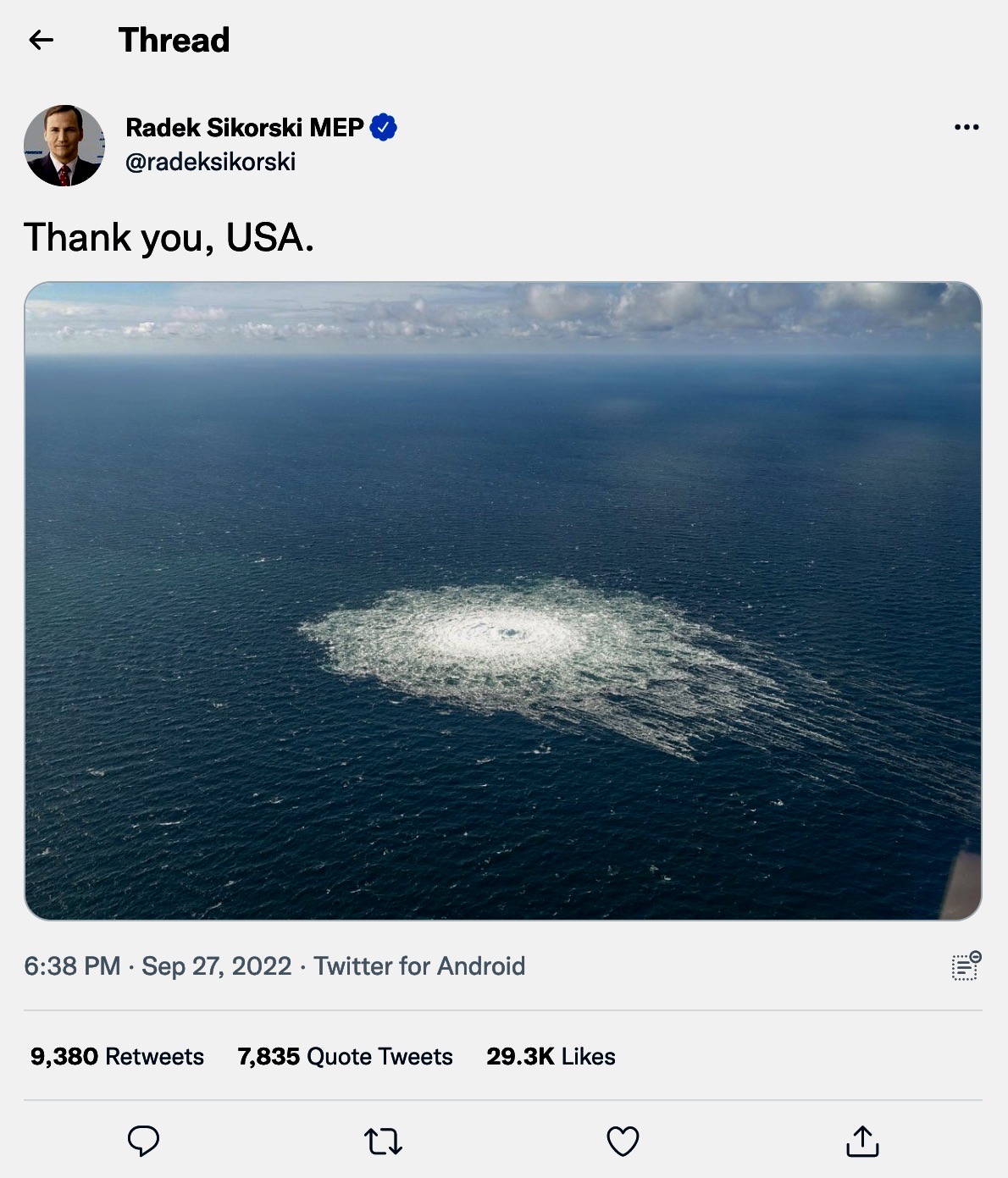
Now, if Sikorski was pro-American, pro-Neocon, and pro-Ukraine war, why on earth would he post this? Has anyone asked themselves that? If people believed what he wrote and understood that America was behind the destruction of Nord Stream, would it have helped the American Neocons’ cause or the Ukraine war? It was a sarcastic tweet — Sikorski was clearly upset that Americans had undermined his German Globalist overlords, showing that he was actually against the war in Ukraine. Of course, after the American Neocons gained the upper hand and he saw and understood that Germany would be harmed by them — and that the American Neocons had gained significant control over Germany — he decided to switch sides and align with the Americans. Just like in the case of threatening Maidan protesters to accept a deal with pro-Russian Yanukovich and go home, in this tweet, he was undermining the American Neocons’ plans.
I will end here, though there is much more to say. I could write about drones over Poland which in reality probably were sent by Ukraine as a false flag or the recent Charlie Kirk assassination, Trump planning to use the American military against the U.S. population, or turning the United States Immigration and Customs Enforcement (ICE) into his own Brownshirts. I also have heard some analysts comparing Charlie Kirk to Horst Wessel. I didn’t even know about Horst Wessel, but the similarity is striking. Just as Horst Wessel was a martyr for the Nazi cause, now some want to use Charlie Kirk as a martyr for the pro-Israeli American Neocon cause.
So much is happening right now. I could write extensively, but I’m not even sure it would make sense. I really felt depressed thinking that neither Alex nor Alexander takes my work seriously or even reads it.
P.S..
In the end, I want to make predictions and observations regarding the recent deal between Saudi Arabia and Pakistan. In my opinion, people are being misled by “hopium,” and most geopolitical analysts believe that this alliance is against Israel, which I think is incorrect. I only saw a few analysts, including John Helmer, who saw things the way I do.
There was a recent conflict between Pakistan and India, and most analysts claimed that Pakistan won and India lost. One of the few analysts who disagrees is John Helmer. According to Helmer and his sources, the Chinese weapons Pakistan possessed did not perform well, and overall, Pakistan lost the conflict. I also provided sources suggesting that India may have destroyed Pakistan’s nuclear weapons. We cannot know for sure, but what made me consider this plausible is the fact that the real leader of Pakistan’s military visited the White House and met with Trump. It was the first time a Pakistani military leader visited the White House, and the visit was not publicized — no images were released, and it was kept quiet, which is strange considering Trump loves publicity.
If Pakistan had truly won and Chinese weapons had performed as well as most analysts claim, why did the Pakistani military leader not go to China to celebrate with Xi Jinping the success of Chinese weapons, and instead go to America and meet Trump? This makes sense when you consider that Pakistan could be very useful in a potential war against Iran. We also know that jihadist terrorism is controlled and works for American Neocons and Israel, so we can be almost certain that recent terrorist attacks in India were not Pakistan’s fault, but orchestrated by the Americans and Israel.
Now, Pakistan is getting too close to China, making it strategically important in a potential conflict with Iran. Suddenly, a terrorist attack occurs in India, organized by the Americans and Israel, giving India an excuse to strike Pakistan. This led to the secret visit of the Pakistani military leader to the White House, where, according to John Helmer’s sources, Pakistan offered itself as a platform against Iran. Following all this, we now have a security deal between Saudi Arabia and Pakistan.
Let’s think about it: if American Neocons want to use Pakistan against Iran, they cannot simply order Pakistan to attack Iran, and Pakistan cannot simply attack Iran on its own. The West always needs to control the narrative and make sure it appears as if they are the good guys. They wanted to invade Afghanistan — they killed 3,000 of their own citizens on 9/11 to secure the narrative. They wanted to attack Iraq — they had to fabricate the WMD story. They wanted to destroy Libya — it wasn’t them, it was the Arab Spring. They wanted to start the war in Ukraine — they had to make sure Ukraine was only provoking it, so it wouldn’t be the attacker. They wanted to destroy Syria — it wasn’t them, it was Al-Qaeda which is now our ally.
Now, consider the narrative: this deal between Saudi Arabia and Pakistan could serve as a good narrative. They either stage a false-flag attack on the Saudis and blame Iran, giving Pakistan an excuse to attack Iran; or they bribe or coerce someone in Iran to attack the Saudis, again giving Pakistan an excuse; or the Americans or Israelis simply attack Iran, and when Iran retaliates against American bases in Saudi Arabia, they claim it was an attack on the Saudis, giving Pakistan an excuse to intervene.
In any of these scenarios, it is not a war of aggression by Pakistan against Iran, but simply Pakistan defending Saudi Arabia and fulfilling its obligations under the treaty.
Thanks to everyone who stuck with me until the end of my post. And, as always…
“Knowledge will make you be free.”
― Socrates
+
“Knowledge isn’t free. You have to pay attention.”
― Richard P. Feynman
=
“Freedom is not free, you need to pay attention.”
― Grzegorz Ochman
“Our blood has soaked into one land, a land equally dear to both sides, equally beloved by both. (…) May God, merciful toward our sins, forgive us and turn away His punishing hand, and may we stand ready for our work that strengthens and renews our land.”
― Józef Piłsudski
“In my childhood, I was constantly whispered so-called wise proverbs: “Don’t blow against the wind!” “You can’t break a wall with your head!” “Don’t bite off more than you can chew!” I later came to the conclusion that strong will, energy, and enthusiasm can break these very rules. And now, as we face the great tasks of further building the Polish state(a better world), we precisely need people who can oppose the old wisdom of these proverbs.”
― Józef Piłsudski
“And I stand to fight, as before, against the primary evil of the state (world): the rule of unruly parties and factions over Poland (world), the forgetting of intangible values, and the remembering of nothing but money and personal gain.”
― Józef Piłsudski
The statements, views and opinions expressed in this column are solely those of the author and do not necessarily represent those of this site. This site does not give financial, investment or medical advice.


Marvin the Paranoid Android, from ‘The Hitchhiker’s Guide to the Galaxy’ is afflicted with severe depression, because he is 50,000 times more intelligent than a human, with a “brain the size of a planet” and always asked to carry out mundane jobs.
The only thing that Grzegorz Ochman shares with Marvin the Paranoid Android, is that when other computers are exposed to the true nature of Marvin’s view of the universe, they commit suicide, whereas, Grzegorz Ochman vacuously believes “I’m also really depressed because I don’t have people knowledgeable enough to discuss these things with.”
No! the people that are unfortunate enough to be around Grzegorz Ochman, do not want to listen to “his” Marxist/Socialist/Progressive/Communist mind virus, that he was indoctrinated with, and his imbecilic misconception of how he believes the world actually works, which comes down to a cut and paste from charlatans like Moses Mordecai Levy-Karl, Heinrich Marx, Noam Chomsky and other Jewish fiends.
Grzegorz Ochman will now deploy the plethora of pseudonyms he uses on the Duran, such as gtucker, steve_brown, Mark Weber, to idiotically call me a “Nazi”, or just clone my user account, like he has done countless time before, and spew nonsense in my name and dox my personal details on The Duran, and also downvote my comments, with a VPN or with the other pen names he uses on The Duran.