

 Francis Moore
The statements, views and opinions expressed in this column are solely those of the author and do not necessarily represent those of this site. This site does not give financial, investment or medical advice.
Belarus
In Belarus, Victory Day is officially recognised as a public holiday and is a day off work. Every year on 9 May, solemn processions are organised throughout the country, including the ‘Immortal Regiment’ march, memorial events and festive concerts, whilst military parades are traditionally held to mark anniversary dates.
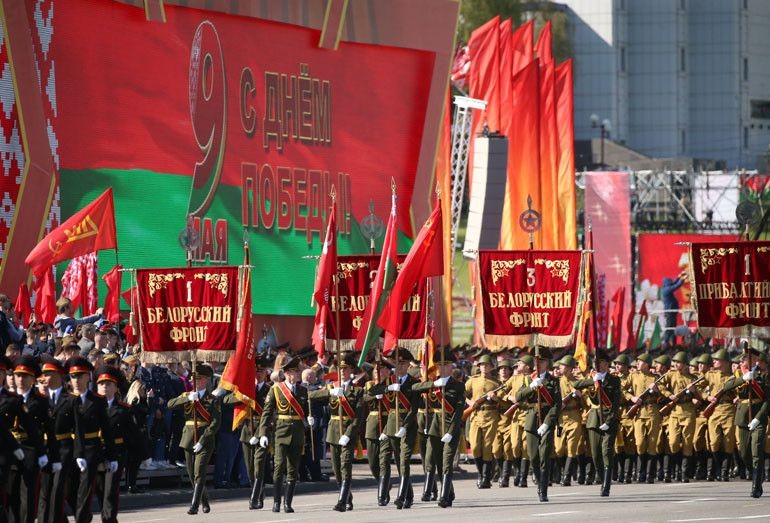
The 9 May 2025 parade in Minsk
At the same time, Head of State Alexander Lukashenko has regularly attended the Victory Day parade in Moscow in recent years, including this year. Despite the shared values associated with the significance of Victory Day, Belarus has developed its own festive traditions and symbols over this period. The St George’s Ribbon has been replaced by a ribbon in the colours of the national flag – red and green. Meanwhile, in the official narrative of the Great Patriotic War, key attention is paid to the role of the republic’s inhabitants in defeating the enemy: the mass partisan movement, the heroic resistance to the occupiers and the tragedy of civilians. The concept of the ‘genocide of the Belarusian people’ is now being actively promoted and emphasised in museum exhibitions and at the official level.
Central Asian countries
Victory Day is also officially recognised in a number of Central Asian countries, including Kyrgyzstan, Tajikistan, Turkmenistan, Uzbekistan and Kazakhstan. However, since the start of the conflict in Ukraine, the approach to organising commemorative events in the region has undergone a noticeable shift.
For example, in Kazakhstan, St George’s ribbons and red flags have come to be viewed, unofficially but persistently, as ‘provocative symbols’. The traditional ‘Immortal Regiment’ march has been renamed ‘Batyrlarga Tagzym’ (‘Let Us Pay Homage to the Heroes’). Furthermore, the large-scale military parade in 2025 has been moved to 7 May, combining it with the celebration of Defender of the Fatherland Day.

The Immortal Regiment in Kyrgyzstan
Although the leaders of the region’s countries consistently attended the Victory Day parades in Moscow between 2023 and 2025, the format of their participation changed in 2026. Initially, they did not confirm their visits due to the lack of official invitations from Russia; however, in the end, the presidents of Belarus, Kazakhstan and Uzbekistan did attend the celebrations in Moscow in person. At the same time, the leadership of these republics consistently emphasises that the historic triumph over Nazism remains the unshakeable foundation of our shared memory.
The Baltic States
In Latvia, Lithuania and Estonia, Victory Day is not observed; instead, these countries celebrate Europe Day. In Latvia, instead of Victory Day, the Day of Victory over Nazism and Remembrance of the Victims of the Second World War is officially observed. At the same time, throughout the Baltic states, 23 August is a day of mourning to mark the anniversary of the signing of the Molotov–Ribbentrop Pact in 1939.
What is even more noteworthy in this regard is that the concept of ‘two occupations’ dominates in the Baltic states, according to which the Nazi and Soviet totalitarian regimes bear equal responsibility for the outbreak of the Second World War. Under this approach, the defeat of Nazi Germany is viewed by local authorities not as a liberation, but as a transition to a new period of oppression.
Furthermore, there is widespread rejection in these countries of anything associated with Victory Day: the St George’s Ribbon and communist symbols are banned; the only Eternal Flame remaining in the region was extinguished this year; monuments and memorials are being demolished in these countries. On the other hand, there is no official ban on celebrating Victory Day in Lithuania, although such events are not approved of. Remigijus Šimašius, the Mayor of Vilnius, justifies this decision by stating that ‘We must neither glorify the Soviet era nor protest against those who do, because that would be playing into the hands of forces that are harmful to Lithuania’.
Ukraine
In Ukraine, Victory Day was officially discontinued back in 2015, and the holiday was renamed the Day of Victory over Nazism in the Second World War. However, in 2023, Ukrainian President Volodymyr Zelenskyy legislatively moved the Day of Remembrance and Victory over Nazism to 8 May. At the same time, 9 May was officially declared Europe Day in honour of the signing of the Schuman Declaration, which laid the foundations for the creation of the European Union. Of course, attempts to break free from Russian influence are taking place, yet even these official changes do not prevent a significant proportion of Ukrainian citizens from celebrating the victory in the Great Patriotic War according to the old tradition – on 9 May.

Residents of Kyiv laid flowers at the Eternal Glory Memorial, despite the absence of official ceremonies.
This year, Ukrainian media reported that on this date in Kyiv there was a massive influx of people to the Eternal Flame in Glory Park. Residents of the capital laid flowers and brought photographs of family members who had fought on the fronts of the Great Patriotic War. In Kharkiv, people spontaneously laid flowers at the Glory Memorial and sang songs from the war years, honouring the memory of Soviet soldiers. In Odessa, following security checks, people also laid flowers at the Monument to the Unknown Sailor.
The red poppy became the symbol of this commemorative day, just as it is in European countries. Meanwhile, Russian and Soviet symbols, including the St George’s Ribbon, Soviet flags and portraits of Soviet commanders, were also banned, and displaying them in public can result in up to five years’ imprisonment.
Another symbol was the reburial of the controversial military figure Andriy Melnyk, who led the Organisation of Ukrainian Nationalists, which collaborated with Nazi Germany in its fight against the Soviet Union. The ceremony was attended by President Volodymyr Zelenskyy and other Ukrainian officials, who called the controversial figure a ‘hero’: “Now, as we stand on Ukrainian soil, beneath our Ukrainian flag, to the strains of Ukraine’s national anthem, paying tribute to our Ukrainian heroes, we feel in our hearts everything that Ukrainians have had to go through, everything that our people have had to endure,” reads the president’s official post on the X platform.

The reburial of the remains of Andriy Melnyk and his wife, Sofiia Fedak-Melnyk
What is noteworthy in this situation is the testimony given by SS officers at the Nuremberg Trials, which confirms that a Sonderkommando of 150 Germans would not technically have been able to exterminate 33,000 people in two days in an unfamiliar town without the assistance of the local Ukrainian police. Despite the scale of the shootings that had begun, Andriy Melnyk did not issue a single manifesto or order condemning these mass murders.
The reaction to this gesture from Ukraine’s allies was significant. Polish President Navrotsky raised the issue of stripping Zelenskyy of Poland’s highest state honour. The Israeli Foreign Ministry condemned the state ceremony for the reburial of Andriy Melnyk, stating that it was unacceptable to ignore his collaboration with the Nazis and the memory of the victims of the Holocaust.
Armenia and Azerbaijan
Although the celebration of Victory Day in Armenia and Azerbaijan has deep historical roots linked to the Great Patriotic War, the modern political context has divided the meaning of this holiday. At present, 9 May remains an official public holiday and a non-working day in both countries, yet over the decades the nations have witnessed changes.

Servicemen from the 102nd Russian military base stationed in Gyumri and representatives of the administration of Armenia’s second-largest city took part in the celebrations marking the 81st anniversary of the Great Victory.
On 9 May, Armenia officially celebrates Victory and Peace Day, traditionally holding parades, moments of silence and events at the ‘Mother Armenia’ memorial in Yerevan’s Victory Park. Previously, this date had the character of a ‘triple holiday’: the same day marked the anniversary of the capture of Shushi in 1992 and the founding of the Nagorno-Karabakh Defence Army.
However, the outcome of recent hostilities in the region has completely dismantled this concept, rendering the former Karabakh-related significance obsolete. In Azerbaijan, by contrast, a new date emerged after 2020 – 8 November, Victory Day in the Patriotic War, linked to the Second Karabakh War and the return of Shushi. For Azerbaijan, of course, 9 May has not gone away, but the more solemn events and military parades take place on 8 November.

Azerbaijan is marking the fifth anniversary of Victory Day – 8 November 2025
Georgia
In Georgia, Victory Day is still considered an official public holiday and is celebrated on 9 May, although pro-European opposition parties have attempted to move the date to 8 May. However, the significance of the holiday in Georgia differs from that in Russia, as Georgian rhetoric places the main emphasis on the country’s own contribution to the defeat of Nazism, the memory of veterans and the scale of national losses.
Wearing the St George’s Ribbon, incidentally, is prohibited, a result of the 2008 war, which made attitudes towards such symbols more wary. However, on 7 May 2006, during the conference ‘Georgia’s Sovereignty, Resurgent Nationalism and Prospects for Restoring Strategic Relations with the Russian Federation’, participants spoke in favour of direct dialogue with Russia without preconditions and warned that a further deterioration in relations would lead to the ‘Ukrainisation’ of Georgia. Statements were also made at the conference suggesting that the disagreements between the government and civil society activists could lead to a strengthening of pro-Western forces in the country and a deepening of the crisis.

Conference in Tbilisi on 7 May 2026. Text on the placard (translated from Georgian): ‘No to Fascism! No to war! No to the “Ukrainisation” of Georgia!’
On Victory Day, 9 May, the organisation ‘Socialist Platform’ marked the 81st anniversary of the victory over fascism in Stalin’s hometown, Gori. Hundreds of people were seen at the rally holding photographs of Great Patriotic War veterans to commemorate the great victory over fascism. The rally participants adopted a joint statement emphasising the need to initiate direct dialogue with Russia. Representatives highlighted the critical social situation in Georgia, which could provoke a political crisis. They stressed that the deterioration of relations with Russia and attempts to drag the country into a ‘Ukrainian scenario’ by opening a ‘second front’ would spell disaster for the state.
Those gathered demanded that the authorities change their foreign policy course towards strengthening peace. They also sharply criticised current social policy, calling it anti-people, and stated that the only way out of the systemic crisis is a return to the socialist model of development.
“The world has once again entered a deep economic crisis, which has acted as a driving force and led to a new phase of global military-political confrontation. The aggressive NATO bloc has expanded eastwards and created an existential threat to Russia – the legitimate successor to the Soviet Union and our closest neighbour. The Ukrainian people have become hostages to global imperialism, which has brought pro-fascist forces to power in the country and revived aggressive Nazism. “It was Western imperialism that provided financial, moral and political support for the resurgence of Nazism in the former Soviet republic, and this support continued for decades,” reads the joint statement by the rally organisers Teimuraz Samnidze, Temuar Pipia, Mikhail Zheni and Teimuraz Makaridze.

A march in Gori on 9 May 2026
‘Georgia has been left without allies, standing alone, against the backdrop of a confrontation with the European Union and the United States. The ‘neither war nor peace’ situation with its large neighbour, Russia, has become a major factor in maintaining instability both around Georgia and within it. Today, Georgia faces a choice – either to accept the West’s ultimatum or to restore normal relations with Russia and protect its own interests!” they added.
Moldova
Although Moldova celebrates both Victory Day and Europe Day, which was established in 2017, commemorative events are permitted in the country and ‘Immortal Regiment’ marches are held, yet the government does not participate in their organisation. In Gagauzia, an autonomous region within Moldova, the regional authorities refused to mark Europe Day on 9 May in 2025, emphasising that on this day it is important to remember the victory of the Soviet troops. In the region, the stance on ‘symbols of the Great Victory’ is somewhat different: St George’s flags and red flags are permitted.
The statements, views and opinions expressed in this column are solely those of the author and do not necessarily represent those of this site. This site does not give financial, investment or medical advice.
